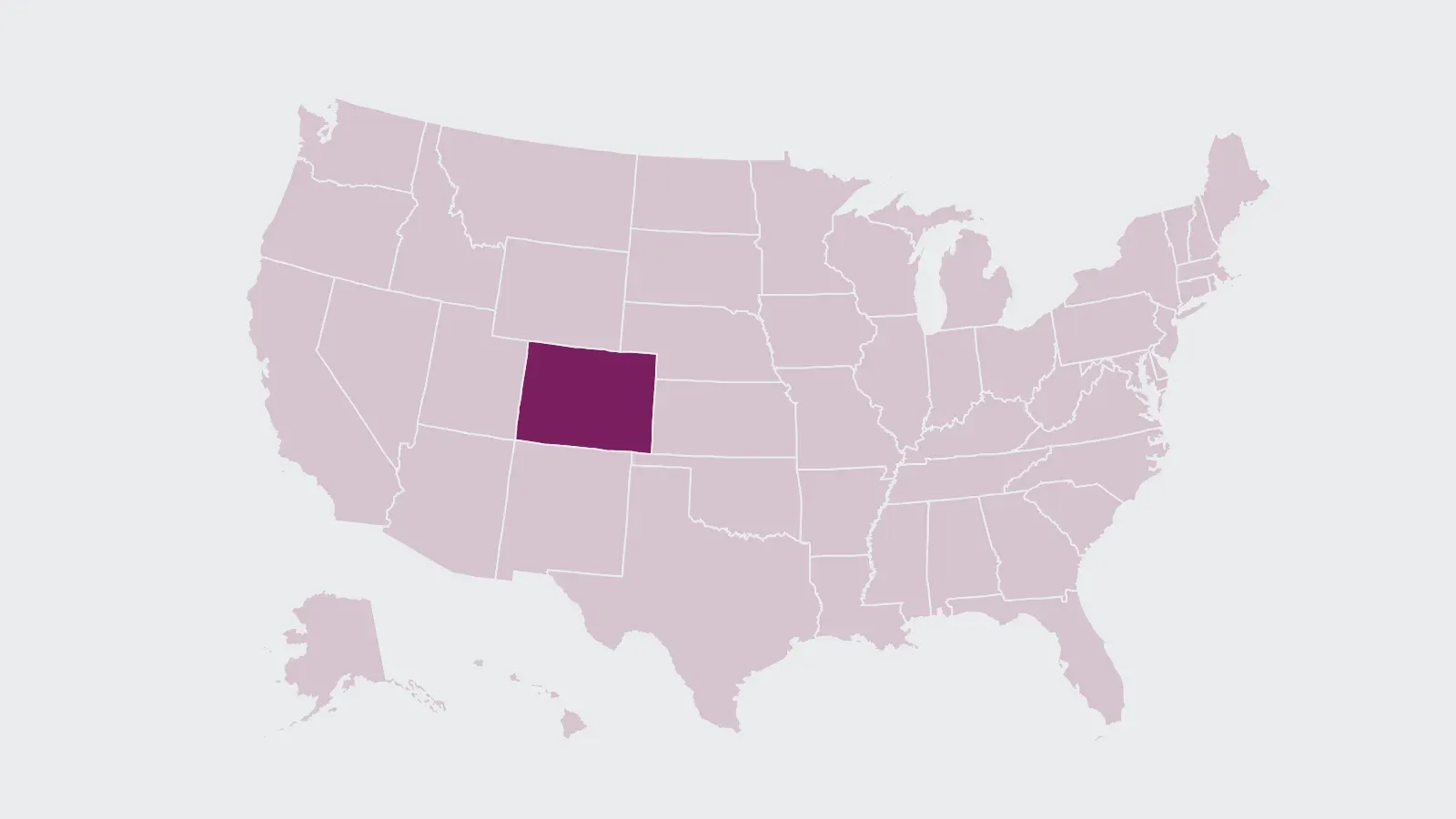
$1,250–$1,499 tier
What Colorado drivers pay for car insurance
The average Colorado premium broken into its parts and set beside the U.S., what a Colorado policy must include, and the levers a driver can pull.
By Guardbrook Editorial Team Updated 5 min read
At a glance
- Average yearly spend, 2023
- $1,453
- Change from 2022
- +14%
- Minimum liability limits
- 25/50/15
- Uninsured drivers, 2023
- 19.7%
Bottom line
Colorado drivers spent an average of $1,453 per insured car in 2023, about 13% more than the U.S. average of $1,282, and full coverage averaged $1,655. Comprehensive cost nearly twice the national figure. The state requires 25/50/15 liability, and $5,000 of medical payments plus uninsured motorist coverage come with a policy unless you reject them. The Division of Insurance links a premium comparison report you can check before shopping.
The Colorado bill, line by line
Guardbrook
Average car insurance bill, 2023
Colorado
Liability$782
Collision$427
Comprehensive$447
Full coverage$1,655
Average spend per car$1,453
Compared with the U.S.+13%
Uninsured drivers19.7%
Average yearly premiums per insured car (NAIC); uninsured share: Insurance Research Council estimate. Averages, not a quote. Where these numbers come from
Price tier on the map
$1,250 to $1,499 a year
- Minimum liability limits
- 25/50/15
- $5,000 medical payments and UM/UIM included unless rejected
- Credit-based insurance scores
- Allowed, not as the only factor
- C.R.S. § 10-4-116: no denial, cancellation or nonrenewal on credit alone
- Regulator
- Colorado Division of Insurance
Colorado's premium against the U.S. average
The National Association of Insurance Commissioners (NAIC) reports average premiums per insured car for every state. For 2023, its latest state year, the Colorado average expenditure was $1,453, up 14% from $1,275 in 2022. That figure includes liability-only cars; a car with liability, collision and comprehensive averaged $1,655.
| Coverage | Colorado | United States |
|---|---|---|
| Liability | $782 | $737 |
| Collision | $427 | $464 |
| Comprehensive | $447 | $238 |
| All three (combined premium) | $1,655 | $1,438 |
| Average expenditure | $1,453 | $1,282 |
Comprehensive is the outlier. At $447 it was about 88% above the U.S. average and higher than Colorado's own collision line ($427), which was about 8% below the national figure. Liability was about 6% above. So most of the extra cost lands on drivers who carry comprehensive. Comprehensive covers damage that isn't a collision, such as theft, fire or weather; see how your location shapes a premium.
What Colorado puts in every policy
The Colorado Division of Insurance lists the minimum liability as $25,000 per person and $50,000 per accident for bodily injury, and $15,000 for property damage: 25/50/15. These are floors: a crash with serious injuries or a newer car can cost far more.
- Medical payments coverage of $5,000 is included unless you reject it, in writing or in the same way you applied for the policy.
- Uninsured and underinsured motorist coverage is optional, but it is included unless you reject it in writing. The Insurance Research Council estimated 19.7% of Colorado drivers were uninsured in 2023, among the higher shares in the country.
- Collision and comprehensive are optional under state law; your lender may require them.
With roughly one driver in five uninsured, dropping uninsured motorist coverage is a larger gamble in Colorado than in most states. Our page on limits and deductibles helps you decide what to keep and what to adjust.
Who sets Colorado prices
The Division of Insurance does not set rates. Insurers file their rates and rating rules with the commissioner, based on their own loss and expense experience, and division staff review those filings (C.R.S. § 10-4-405). Because each company prices its own way, quotes for the same driver can differ, and the division links a premium comparison report from its auto insurance page.
Colorado lets insurers use credit information in personal lines, within limits (C.R.S. § 10-4-116). An insurer may not deny, cancel or refuse to renew a policy on credit information without considering another underwriting factor that is independent of credit. Scores can't be built from income, gender, address or ZIP code, and credit damaged by a divorce or by corroborated identity theft can't be held against you. If credit leads to an adverse action, the insurer must send the notice federal law requires (C.R.S. § 10-4-616). More on credit-based insurance scores.
Coverage for drivers who are turned away
Colorado's assigned-risk plan, listed by its administrator AIPSO as the Colorado Automobile Insurance Plan, serves eligible drivers who can't get coverage in the voluntary market. An agent can apply for you, or call the plan office at (800) 227-4659. Plan premiums are usually higher; our guide to assigned-risk plans explains what to expect.
Ways to bring a Colorado bill down
- Start with the division's premium comparison. The report linked from its auto insurance page can help you pick which insurers to ask, then get two or three quotes on identical coverage.
- Look hard at comprehensive. Since it is the costliest line relative to the U.S., test a higher comprehensive deductible with the deductible break-even calculator.
- Bundle and ask for discounts. Insurers often price home and auto together; see bundling home and auto.
- Reach the division with a problem. Call 303-894-7499, or 800-930-3745 toll-free from outside the Denver area; complaints can also be filed online.
Questions drivers ask
Why is car insurance expensive in Colorado?
On NAIC's 2023 data the biggest gap is comprehensive: $447 per insured car against $238 nationally. Liability was also slightly above average, and overall spending was $1,453 against $1,282.
What is the minimum car insurance in Colorado?
25/50/15: $25,000 per person and $50,000 per accident for injuries, and $15,000 for property damage. Medical payments of $5,000 is added unless you reject it.
Do I have to carry uninsured motorist coverage in Colorado?
It's optional, but it is included in your policy unless you reject it in writing. About 19.7% of Colorado drivers were uninsured in 2023, by the Insurance Research Council's estimate.
Can a Colorado insurer cancel my policy because of my credit?
Not on credit alone. The insurer must also consider another underwriting factor that is independent of credit. See credit-based insurance scores.
Where the figures come from
- NAIC — Auto Insurance Database Report 2022/2023 (state average premiums and expenditures)
- Colorado Division of Insurance — Auto insurance
- C.R.S. § 10-4-116 — Use of credit information (colorado.public.law)
- C.R.S. § 10-4-616 — Disclosure of credit reports (colorado.public.law)
- C.R.S. § 10-4-405 — Filing of rating information (colorado.public.law)
- AIPSO — Colorado Automobile Insurance Plan
- Insurance Information Institute — Uninsured motorists (Insurance Research Council estimates)
Facts on this page were checked against these sources on October 26, 2026. NAIC averages are for 2023, the latest year the NAIC has published by state.
Have your rate shopped
Averages can't price your car and your record. Tell us the basics of your policy and Guardbrook passes them to licensed insurance agents and insurers who can quote it; you decide whether to switch.
- 1 Your cars, drivers and current policy.
- 2 How agents can reach you, and your consent.
- 3 A licensed insurance agent or insurer contacts you with quotes. Your policy stays as it is until you decide to switch.
Guardbrook is not an insurance company or agency and doesn't sell, quote or bind policies. You pay Guardbrook nothing; the licensed insurance agents and insurers who contact you set their own prices and terms. How we make money.
Read next
-

Price factor
Location and ZIP code
2023 state averages ran from $808 to $1,864 per car. Why your address matters and where ZIP codes are barred.
-

Way to save
Raising your deductible
$500 to $1,000 can save $150 a year in our example and needs about 3.3 claim-free years to pay off.
-

Shopping guide
Reading your declarations page
Drivers, cars, limits such as 50/100/50, deductibles, rejected coverages, required discounts and the premium.