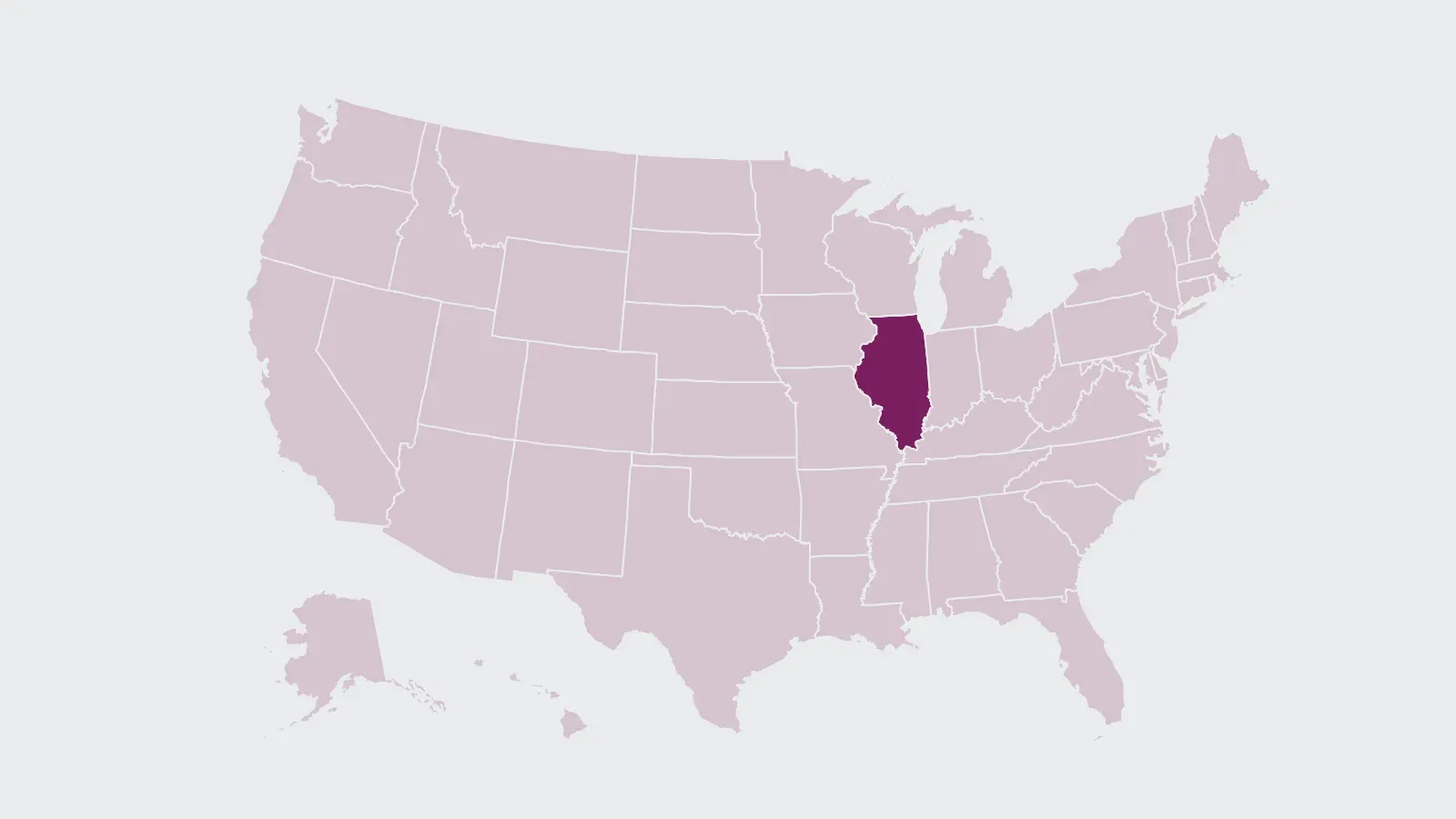
$1,000–$1,249 tier
What car insurance costs in Illinois
Illinois's average premium against the national one, the coverage Illinois law requires, and a new rate-review law that changes how increases are handled.
By Guardbrook Editorial Team Updated 6 min read
At a glance
- Average yearly spend, 2023
- $1,153
- Change from 2022
- +16%
- Minimum liability limits
- 25/50/20
- Uninsured drivers, 2023
- 15.2%
Bottom line
Illinois drivers spent an average of $1,153 per insured car in 2023, 10% below the U.S. average of $1,282, though that was 16% more than a year earlier; full coverage averaged $1,257. The state requires 25/50/20 liability and 25/50 uninsured motorist coverage. A law signed in August 2026 lets the Department of Insurance object to excessive or unfairly discriminatory auto rates from July 1, 2027, and requires 30 days' notice before a renewal increase of more than 10%.
The Illinois bill, line by line
Guardbrook
Average car insurance bill, 2023
Illinois
Liability$598
Collision$440
Comprehensive$219
Full coverage$1,257
Average spend per car$1,153
Compared with the U.S.−10%
Uninsured drivers15.2%
Average yearly premiums per insured car (NAIC); uninsured share: Insurance Research Council estimate. Averages, not a quote. Where these numbers come from
Price tier on the map
$1,000 to $1,249 a year
- Minimum liability limits
- 25/50/20
- Plus uninsured motorist bodily injury of 25/50; underinsured required with higher UM limits
- Credit-based insurance scores
- Allowed, not as the only factor
- 215 ILCS 157; exception review after divorce, illness, a death in the family, job loss or identity theft
- Regulator
- Illinois Department of Insurance
Illinois's bill and the U.S. average
The National Association of Insurance Commissioners (NAIC) reports average premiums for each state from insurers' own data; the newest state year is 2023. Illinois's average expenditure that year was $1,153 per insured car, up 16% from $994 in 2022, a faster rise than the national 14%. Expenditure blends liability-only cars with fully covered ones. With liability, collision and comprehensive together, the average was $1,257.
| Coverage | Illinois | United States |
|---|---|---|
| Liability | $598 | $737 |
| Collision | $440 | $464 |
| Comprehensive | $219 | $238 |
| All three (combined premium) | $1,257 | $1,438 |
| Average expenditure | $1,153 | $1,282 |
Every Illinois line sat below the national figure. Liability was the furthest under, about 19% lower, while collision and comprehensive were within roughly 5% to 8% of the U.S. averages. The 16% one-year jump, though, was among the five largest in the table. A statewide average also hides wide differences between drivers; a past claim is one personal factor that can raise a quote, as our page on claims history explains.
Coverage Illinois law requires
Every vehicle owner in Illinois must carry liability insurance. The minimums are $25,000 for one injured person, $50,000 per accident for injuries and $20,000 for property damage, or 25/50/20. The Illinois Department of Insurance notes that these amounts may not be enough to protect you from a lawsuit.
- Uninsured motorist bodily injury coverage is part of the requirement, at least $25,000 per person and $50,000 per accident.
- Underinsured motorist coverage is required if you buy uninsured motorist limits above the minimum.
- Uninsured motorist property damage is optional; insurers must offer it, with a deductible of no more than $250.
About 15.2% of Illinois drivers were uninsured in 2023, according to the Insurance Research Council's estimate, close to the national 15.4%. If you raise your liability limits, matching your uninsured motorist limits also brings in underinsured coverage. Our guide to limits and deductibles shows how to price those choices.
How Illinois handles rates and credit
Oversight of Illinois auto rates is about to change. Senate Bill 714 (Public Act 104-0753), signed by the governor on August 4, 2026 and taking effect July 1, 2027, requires insurers to justify their auto rates and lets the Department of Insurance object to rates that are excessive, inadequate or unfairly discriminatory. Insurers will also have to give customers at least 30 days' notice before a renewal increase of more than 10%.
The new law doesn't specifically ban rating on credit, NPR Illinois noted. The Department's shopping guide says companies may review your credit and may charge more based on it. The Use of Credit Information in Personal Insurance Act (215 ILCS 157) sets the limits: no refusal, cancellation or nonrenewal solely on credit; a written explanation of up to four main reasons when credit works against you; and an exception review, if you send a signed explanation, after a catastrophic illness or injury, the death of a spouse, child or parent, a job loss of three months or more, identity theft or divorce. See credit-based insurance scores.
The Illinois Automobile Insurance Plan
If your driving record or your vehicle keeps you from finding coverage, the Illinois Automobile Insurance Plan is the fallback. To qualify, you must have been turned down by other insurers, hold a valid license or be eligible for one, owe no unpaid premium from the past 36 months and drive a safe vehicle. Ask your agent first; any agent or broker licensed for auto insurance in Illinois can submit an application. Our guide to assigned risk plans explains the trade-offs.
Paying less in Illinois
- Get quotes that match. Ask two or three companies to price the same liability, uninsured motorist and deductible choices so the comparison is fair.
- Check a bundle. If you also insure a home or apartment, ask what the same company would charge for both; our page on bundling home and auto explains when it helps.
- Check complaint ratios. The Department of Insurance posts complaint ratios for companies with 10 or more auto insurance complaints, a useful check before you switch.
- Question a rate increase. Ask the insurer what changed, then contact the Department in Chicago at (312) 814-2420 or in Springfield at (217) 782-4515, or file a complaint online. Our guide to complaining about a rate increase lays out the steps.
Questions drivers ask
Is car insurance in Illinois cheaper than the national average?
Yes, on average. NAIC data for 2023 put the Illinois average expenditure at $1,153 per insured car against $1,282 nationally, and full coverage at $1,257 against $1,438.
What is the minimum car insurance in Illinois?
25/50/20 liability plus uninsured motorist bodily injury coverage of at least $25,000 per person and $50,000 per accident.
Does Illinois approve car insurance rate increases?
Not today: the governor's office says the state has lacked authority to challenge auto rates. Under SB 714, from July 1, 2027 insurers must justify auto rates and the Department of Insurance can object to rates that are excessive, inadequate or unfairly discriminatory. Insurers must also give at least 30 days' notice of renewal increases above 10%.
Can an Illinois insurer use my credit?
Yes, with limits. It can't refuse, cancel or nonrenew solely on credit, and you can ask for an exception after events such as divorce, a serious illness, a death in the family, a job loss or identity theft.
Where the figures come from
- NAIC — Auto Insurance Database Report 2022/2023 (state average premiums and expenditures)
- Illinois Department of Insurance — Auto Insurance Shopping Guide
- Illinois Department of Insurance — Auto insurance consumer pages
- Use of Credit Information in Personal Insurance Act, 215 ILCS 157 (Justia, 2025)
- AIPSO — Illinois Automobile Insurance Plan
- Office of the Governor — Gov. Pritzker signs insurance reforms (HB 4273 and SB 714, Aug. 4, 2026)
- LegiScan — Illinois SB 714 (Public Act 104-0753): status, effective date and synopsis
- NPR Illinois — Pritzker signs bills allowing state to review insurance rate hikes (Aug. 4, 2026)
- Insurance Information Institute — Uninsured motorists (Insurance Research Council estimates)
Facts on this page were checked against these sources on October 26, 2026. NAIC averages are for 2023, the latest year the NAIC has published by state; the SB 714 rate-review rules take effect on July 1, 2027.
Have your rate shopped
Averages can't price your car and your record. Tell us the basics of your policy and Guardbrook passes them to licensed insurance agents and insurers who can quote it; you decide whether to switch.
- 1 Your cars, drivers and current policy.
- 2 How agents can reach you, and your consent.
- 3 A licensed insurance agent or insurer contacts you with quotes. Your policy stays as it is until you decide to switch.
Guardbrook is not an insurance company or agency and doesn't sell, quote or bind policies. You pay Guardbrook nothing; the licensed insurance agents and insurers who contact you set their own prices and terms. How we make money.
Read next
-
Price factor
Claims history
A CLUE report shows up to 7 years of auto claims. Get a free copy every 12 months and fix errors before you shop.
-

Shopping guide
Complaining about a rate increase
Ask the insurer, use your adverse action rights, read the filing, then complain; Maryland gives you 30 days.
-
Way to save
Bundling home and auto
Wisconsin's regulator puts the package discount at up to 15%. Why a bundle can still cost more than two policies.