Under $1,000 tier
What car insurance costs in Indiana
Indiana's average bill set against the national one, the coverage the state requires, and the steps that keep a Hoosier premium in check.
By Guardbrook Editorial Team Updated 5 min read
At a glance
- Average yearly spend, 2023
- $926
- Change from 2022
- +14%
- Minimum liability limits
- 25/50/25
- Uninsured drivers, 2023
- 14.0%
Bottom line
Indiana drivers spent an average of $926 per insured car in 2023, about 28% less than the U.S. average of $1,282. A car carrying liability, collision and comprehensive averaged $1,032. The state requires 25/50/25 liability, and uninsured and underinsured motorist coverage is part of a new policy unless you reject it in writing. A low state average doesn't make your quote low: insurers file their own rates, so prices for the same driver still differ from company to company.
The Indiana bill, line by line
Guardbrook
Average car insurance bill, 2023
Indiana
Liability$485
Collision$357
Comprehensive$189
Full coverage$1,032
Average spend per car$926
Compared with the U.S.−28%
Uninsured drivers14.0%
Average yearly premiums per insured car (NAIC); uninsured share: Insurance Research Council estimate. Averages, not a quote. Where these numbers come from
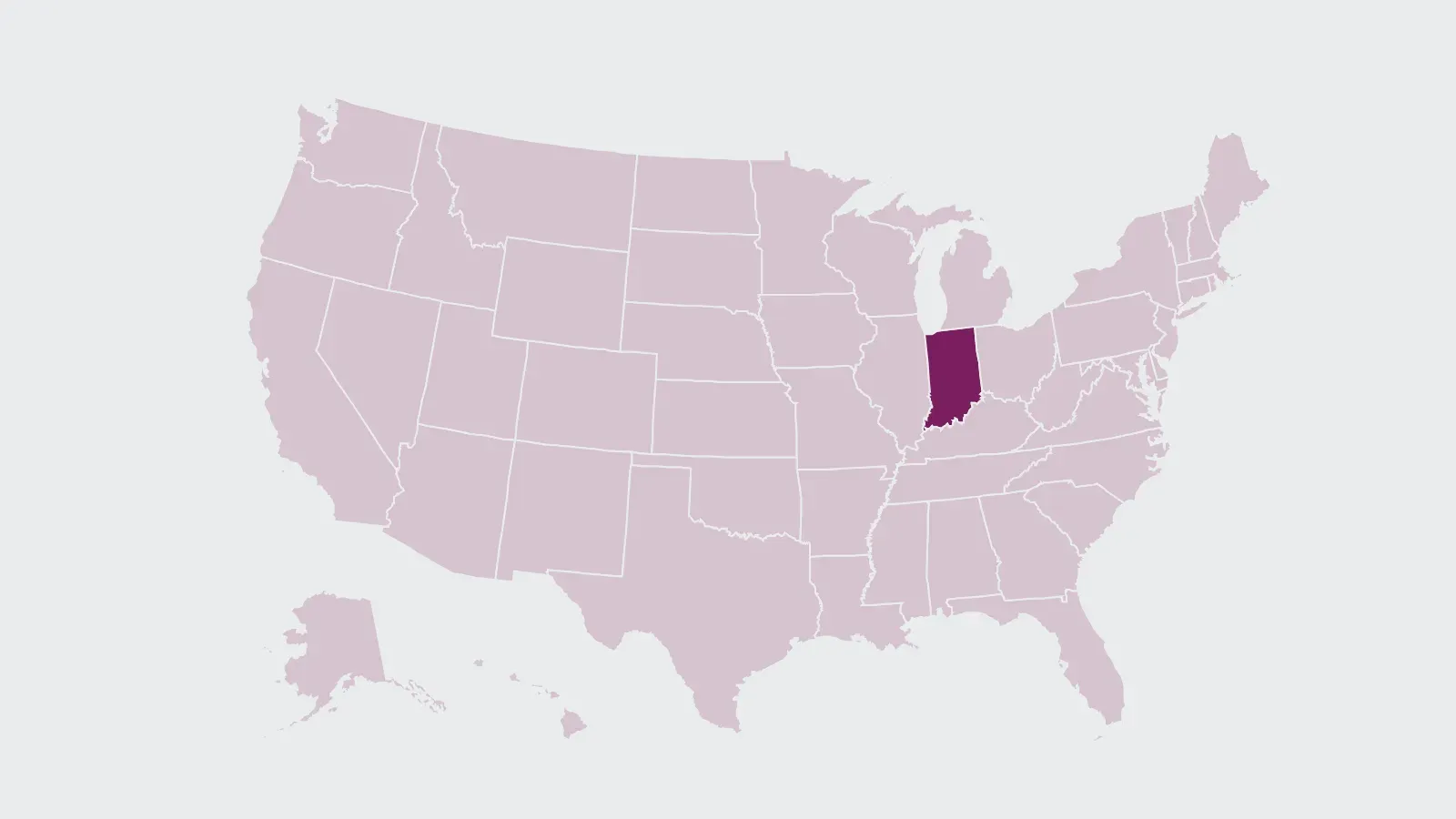
Price tier on the map
Under $1,000 a year
- Minimum liability limits
- 25/50/25
- Uninsured/underinsured motorist coverage included unless rejected in writing
- Credit-based insurance scores
- Allowed, not as the only factor
- IC 27-2-21 and IDOI Bulletin 130: not the sole basis to deny, cancel, nonrenew or set a renewal rate
- Regulator
- Indiana Department of Insurance
Indiana's bill next to the national one
Each year the National Association of Insurance Commissioners (NAIC) adds up the premiums insurers collected in every state. For 2023, its most recent state data, the average Indiana expenditure was $926 per insured car, 14% more than the $814 recorded for 2022. That average blends liability-only policies with full coverage; a car insured for all three main coverages averaged $1,032.
| Coverage | Indiana | United States |
|---|---|---|
| Liability | $485 | $737 |
| Collision | $357 | $464 |
| Comprehensive | $189 | $238 |
| All three (combined premium) | $1,032 | $1,438 |
| Average expenditure | $926 | $1,282 |
Indiana sits under the national figure on every line. The widest gap is liability: $485 is roughly two-thirds of the U.S. average, and liability is the part of the bill the law makes you buy. Collision and comprehensive are closer to the national numbers, about 20% to 25% lower. Within the state, your price still turns on your car, your record and where you garage it; see how your ZIP code moves a premium.
The coverage Indiana requires
Indiana Code 9-25-4-5 sets the minimum financial responsibility at $25,000 for injury to one person, $50,000 for injuries to two or more people in one accident and $25,000 for property damage: 25/50/25. Those are floors. A crash that injures several people or wrecks a newer car can run past them, and anything above your limit can come back to you.
- Uninsured and underinsured motorist coverage must be included in every newly written Indiana liability policy unless you turn it down in writing. The Indiana Department of Insurance (IDOI) lists minimums of $25,000/$50,000 for uninsured motorist bodily injury, $25,000 for uninsured motorist property damage and $50,000 for underinsured motorist bodily injury.
- Medical payments coverage is optional. It pays medical bills for you and usually your passengers after a crash, up to the limit you choose.
- Collision and comprehensive protect your own car. Indiana's minimum doesn't include them, but a lender or lessor will usually insist on both.
After an accident or certain traffic violations, the Bureau of Motor Vehicles can ask for proof that you were insured. Your agent files a Certificate of Compliance for you, and the IDOI warns that it must go to the BMV, not to the department, or you risk your driving privileges. Before cutting a coverage to save money, read our page on limits and deductibles.
How Indiana insurers set their prices
The IDOI doesn't set car insurance rates. Each insurer files its rates and policy forms with the department before using them, the rates must not be excessive, inadequate or unfairly discriminatory, and the filings are open to the public. Because every company prices on its own, the IDOI suggests talking to several agents and comparing policies on the same basis rather than on price alone.
The department lists credit scores among the factors an insurer may weigh, next to age, sex, marital status, driving record, how the car is used, where you live, the limits and deductibles you pick, the vehicle, driver training and claims history. Under IC 27-2-21, as the department explains in Bulletin 130, an insurer can't deny, cancel or nonrenew a policy, or set a renewal rate, solely on credit information, and a score can't use medical collection accounts or treat insurance inquiries as negatives. Our page on credit-based insurance scores explains how that factor tends to work.
Indiana also limits how a policy can end. An insurer may cancel a new policy within its first 60 days; after that, only for specific reasons such as nonpayment or losing your license. At the end of a term it may decline to renew, but it must give you 20 days' notice, enough time to shop.
Turned down? The Indiana Automobile Insurance Plan
If regular insurers won't cover you, any Indiana insurance agent can apply for you through the Indiana Automobile Insurance Plan. Every insurer licensed in the state takes a share of these drivers, in proportion to its share of the voluntary market. It is meant as a bridge while your record ages, and our guide to assigned-risk plans covers what to expect from one.
Keeping an Indiana premium down
- Collect quotes on identical coverage. Ask two or three insurers for the same limits and deductibles, then compare the quotes line by line.
- Question every discount. Multi-car, home and auto together, driver training and a claims-free record are common; each company decides what it offers and how much it is worth.
- Weigh a higher deductible. It lowers the collision and comprehensive premium; the deductible break-even calculator shows when it pays off.
- Complain when something looks wrong. Start with your insurer or agent. If that fails, file with the IDOI Consumer Services Division online or call 1-800-622-4461; the company gets 20 business days to answer the department in writing.
Questions drivers ask
Is car insurance cheaper in Indiana than in most of the country?
On average, yes. The NAIC put Indiana's 2023 average expenditure at $926 per insured car against $1,282 nationally, and the full-coverage combined premium at $1,032 against $1,438.
What are Indiana's minimum car insurance limits?
25/50/25: $25,000 for one person's injuries, $50,000 for all injuries in one accident and $25,000 for property damage, under Indiana Code 9-25-4-5.
Can I turn down uninsured motorist coverage in Indiana?
Yes, but only in writing. Without a written rejection, a newly written Indiana policy includes uninsured and underinsured motorist coverage. About 14% of Indiana drivers were uninsured in 2023, by the Insurance Research Council's estimate.
Where can I get insurance if companies keep refusing me?
Ask any Indiana agent to place you in the Indiana Automobile Insurance Plan. See how assigned-risk plans work.
Where the figures come from
- NAIC — Auto Insurance Database Report 2022/2023 (state average premiums and expenditures)
- Indiana Department of Insurance — Bulletin 130, use of credit information in underwriting and rating (2005)
- Indiana Department of Insurance — Auto insurance
- Indiana Department of Insurance — Complaints
- Indiana Code § 9-25-4-5 — Minimum amounts of financial responsibility (Justia)
- AIPSO — Indiana Automobile Insurance Plan
- Insurance Information Institute — Uninsured motorists (Insurance Research Council estimates)
Facts on this page were checked against these sources on October 26, 2026. NAIC averages are for 2023, the latest year the NAIC has published by state.
Have your rate shopped
Averages can't price your car and your record. Tell us the basics of your policy and Guardbrook passes them to licensed insurance agents and insurers who can quote it; you decide whether to switch.
- 1 Your cars, drivers and current policy.
- 2 How agents can reach you, and your consent.
- 3 A licensed insurance agent or insurer contacts you with quotes. Your policy stays as it is until you decide to switch.
Guardbrook is not an insurance company or agency and doesn't sell, quote or bind policies. You pay Guardbrook nothing; the licensed insurance agents and insurers who contact you set their own prices and terms. How we make money.
Read next
-

Price factor
Driving record
Tickets and at-fault crashes raise prices; OR and MD look back 3 years, CA Good Driver rates are 20%+ lower.
-

Shopping guide
Assigned-risk plans
Turned down twice in Texas or Maryland? How state plans place you, what they cover and how to get back out.
-

Way to save
Raising your deductible
$500 to $1,000 can save $150 a year in our example and needs about 3.3 claim-free years to pay off.