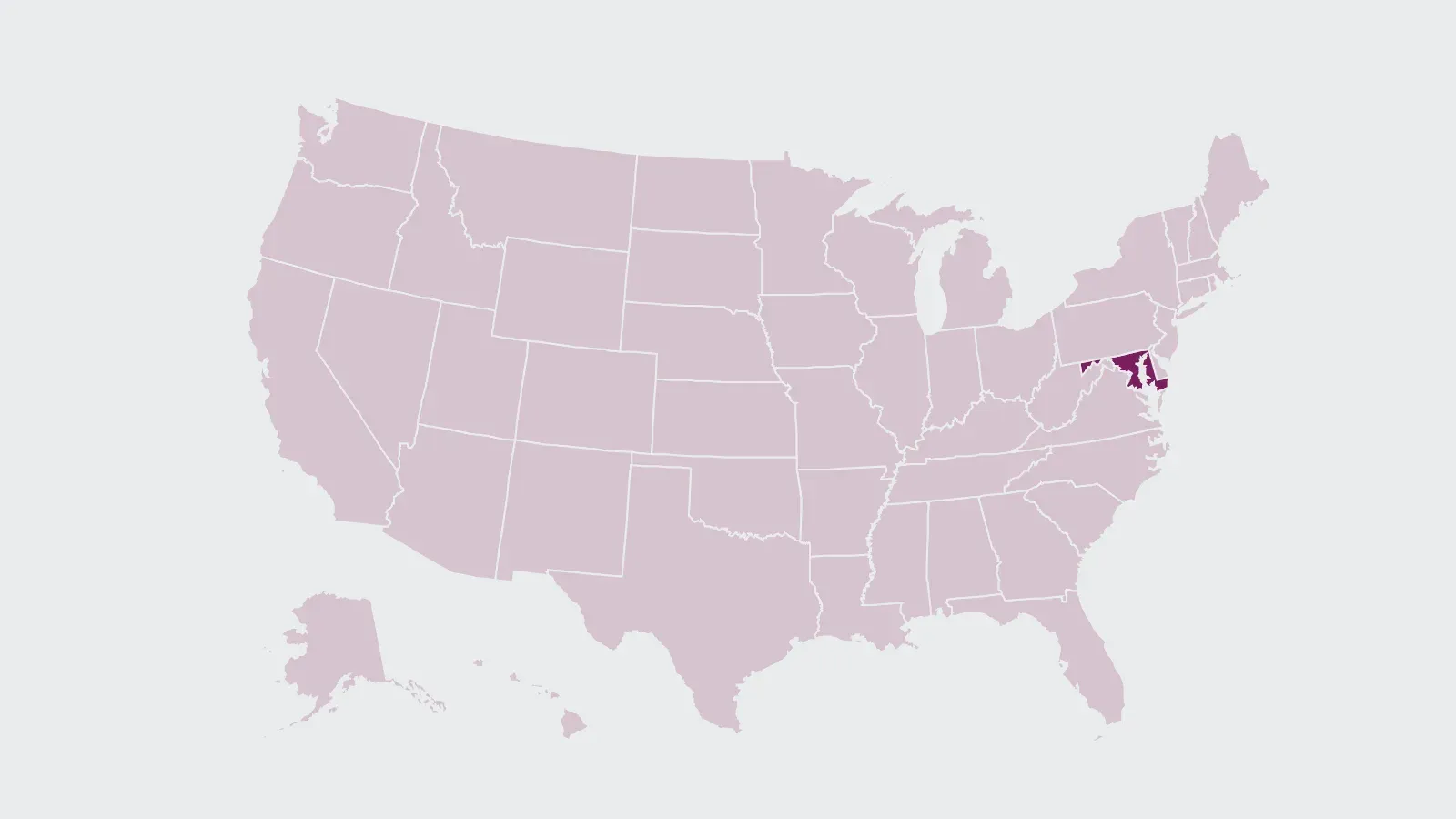
$1,250–$1,499 tier
What car insurance costs in Maryland
Maryland's average premium against the national figure, the coverage the state requires, the limits on how insurers price, and the insurer of last resort.
By Guardbrook Editorial Team Updated 6 min read
At a glance
- Average yearly spend, 2023
- $1,477
- Change from 2022
- +15%
- Minimum liability limits
- 30/60/15
- Uninsured drivers, 2023
- 16.9%
Bottom line
Maryland drivers spent an average of $1,477 per insured car in 2023, about 15% above the U.S. average of $1,282, and a car with all three main coverages averaged $1,602. The state requires 30/60/15 liability, uninsured motorist coverage at the same limits and $2,500 of PIP unless waived. Maryland puts unusual limits on pricing: no renewal increase for worse credit, no surcharge for accidents or tickets more than three years old. The state publishes a rate comparison guide, and the Maryland Automobile Insurance Fund covers drivers turned down by two insurers.
The Maryland bill, line by line
Guardbrook
Average car insurance bill, 2023
Maryland
Liability$869
Collision$514
Comprehensive$220
Full coverage$1,602
Average spend per car$1,477
Compared with the U.S.+15%
Uninsured drivers16.9%
Average yearly premiums per insured car (NAIC); uninsured share: Insurance Research Council estimate. Averages, not a quote. Where these numbers come from
Price tier on the map
$1,250 to $1,499 a year
- Minimum liability limits
- 30/60/15
- Plus uninsured motorist 30/60/15 and $2,500 PIP unless waived
- Credit-based insurance scores
- Allowed for new policies, with limits
- No renewal increase or cancellation for credit; 40% surcharge cap (Maryland Insurance Administration)
- Regulator
- Maryland Insurance Administration
Maryland's average premium in context
The National Association of Insurance Commissioners (NAIC) reports the premiums insurers collect, state by state. In 2023, the latest year it has published, Maryland's average expenditure was $1,477 per insured car, 15% above the $1,281 of 2022. Expenditure includes liability-only policies; a car carrying liability, collision and comprehensive cost $1,602 on average.
| Coverage | Maryland | United States |
|---|---|---|
| Liability | $869 | $737 |
| Collision | $514 | $464 |
| Comprehensive | $220 | $238 |
| All three (combined premium) | $1,602 | $1,438 |
| Average expenditure | $1,477 | $1,282 |
Most of the difference sits in liability, which at $869 is about 18% above the U.S. figure. Collision is about 11% higher, while comprehensive is the one line below the national average, by about 8%. Because liability includes the coverage the law requires, a Maryland driver who carries only the minimum still feels most of that gap. The car you drive changes the collision side; see how make and model affect price.
Coverage every Maryland policy needs
The Maryland Insurance Administration (MIA) lists the legal minimum as $30,000 of bodily injury liability per person and $60,000 per accident, plus $15,000 for property damage, written 30/60/15. Two more coverages come with it.
- Uninsured motorist coverage of at least $30,000/$60,000 for injuries and $15,000 for property damage. In Maryland it includes underinsured motorist protection, and insurers also offer an enhanced underinsured motorist option.
- Personal injury protection (PIP) of at least $2,500 must be offered. Some policyholders can waive it or buy Limited PIP that excludes listed drivers and household members over 16; it lowers the premium but drops benefits such as lost wages that health insurance usually doesn't pay.
- Collision and comprehensive are optional under state law, though a lender or lessor will usually require them.
The Insurance Research Council estimates that 16.9% of Maryland drivers were uninsured in 2023, above the 15.4% national rate. That is an argument for weighing higher uninsured motorist limits before trimming them; our page on limits and deductibles walks through the choice.
Maryland's rules on how insurers price
Maryland law requires insurers to file their rates and any rate increase requests with the MIA, which reviews them to make sure they are not excessive, inadequate or unfairly discriminatory. Within that system, several rules protect individual drivers:
- An insurer can't raise your rate over an accident or traffic violation more than three years old.
- A renewal premium increase must be mailed to you at least 45 days before the renewal takes effect. If the increase stems from a claim or ticket, you can file a complaint within 30 days of the notice; if the MIA finds it improper, the insurer must refund the overpayment.
- An insurer can't make you buy a homeowners policy to get car insurance.
Credit history may help set the price of a new policy only. Insurers must say at application that they consider it, can't add a credit surcharge above 40%, and can't count a missing credit history, the number of inquiries or anything more than five years old. They may not use credit to cancel, refuse to renew or raise a renewal premium, and you can ask for a recheck once per policy period: better credit can lower the renewal price, worse credit can't raise it. Our guide to credit-based insurance scores has more.
MAIF, Maryland's insurer of last resort
Maryland residents turned down by at least two private insurers can apply to the Maryland Automobile Insurance Fund (MAIF), which does business as Maryland Auto Insurance (800-492-7120). It generally offers the state minimum 30/60/15 limits, and the MIA's comparison guide also prices 100/300/100. Other insurers are barred by law from refusing you because you were insured by MAIF, so you can move back once your record improves. Our guide to state low-cost and last-resort programs compares MAIF with other states' options.
How to pay less in Maryland
- Start with the MIA's rate comparison guide. The August 2026 edition shows sample annual premiums from the insurers writing the most Maryland policies, MAIF included, for 22 driver profiles by region and ZIP code, and marks which companies use credit.
- Ask for the good-driver discount. By law, an insurer must offer a discount if you have had no moving violation carrying more than one point and no at-fault accident in the past three years, with continuous coverage from that insurer.
- Decide how to pay. Paying the premium in full can cost less than monthly installments; see paying in full versus monthly.
- Complain if a rate looks wrong. The MIA's Property and Casualty complaint unit answers at 410-468-2340 or 800-492-6116, extension 2340; filing online is the preferred route.
Questions drivers ask
Is car insurance more expensive in Maryland than the national average?
Yes. The NAIC put Maryland's 2023 average expenditure at $1,477 per insured car against $1,282 nationally, and the full-coverage combined premium at $1,602 against $1,438.
What is the Maryland Automobile Insurance Fund?
MAIF, doing business as Maryland Auto Insurance, sells coverage to Maryland residents who have been turned down by at least two private insurers. Its phone number is 800-492-7120.
Can my Maryland insurer raise my renewal premium because my credit got worse?
No. Maryland lets insurers use credit to price a new policy, but not to raise a renewal premium, cancel or refuse to renew. You can ask for a recheck once per policy period, and better credit can lower your renewal price.
What are Maryland's minimum car insurance requirements?
Liability of 30/60/15, uninsured motorist coverage of at least 30/60/15, and $2,500 of PIP unless you waive it.
Where the figures come from
- NAIC — Auto Insurance Database Report 2022/2023 (state average premiums and expenditures)
- Maryland Insurance Administration — A Consumer Guide to Auto Insurance
- Maryland Insurance Administration — Automobile insurance rates
- Maryland Insurance Administration — Use of your credit history for auto insurance
- Maryland Insurance Administration — Comparison Guide to Automobile Insurance Rates (August 2026)
- Insurance Information Institute — Uninsured motorists (Insurance Research Council estimates)
Facts on this page were checked against these sources on October 26, 2026. NAIC averages are for 2023, the latest year the NAIC has published by state.
Have your rate shopped
Averages can't price your car and your record. Tell us the basics of your policy and Guardbrook passes them to licensed insurance agents and insurers who can quote it; you decide whether to switch.
- 1 Your cars, drivers and current policy.
- 2 How agents can reach you, and your consent.
- 3 A licensed insurance agent or insurer contacts you with quotes. Your policy stays as it is until you decide to switch.
Guardbrook is not an insurance company or agency and doesn't sell, quote or bind policies. You pay Guardbrook nothing; the licensed insurance agents and insurers who contact you set their own prices and terms. How we make money.
Read next
-
Price factor
Vehicle make and model
The car drives collision and comprehensive, $464 and $238 a year on average in 2023. How to check a model first.
-
Shopping guide
State low-cost programs
California's 10/20/3 policy, New Jersey's $365 Medicaid policy, Hawaii's free minimums and Maryland's MAIF.
-
Way to save
Paying in full vs. monthly
A $1,200 premium can cost $45 more by the month, about 17.8% as an APR. When monthly still makes sense.