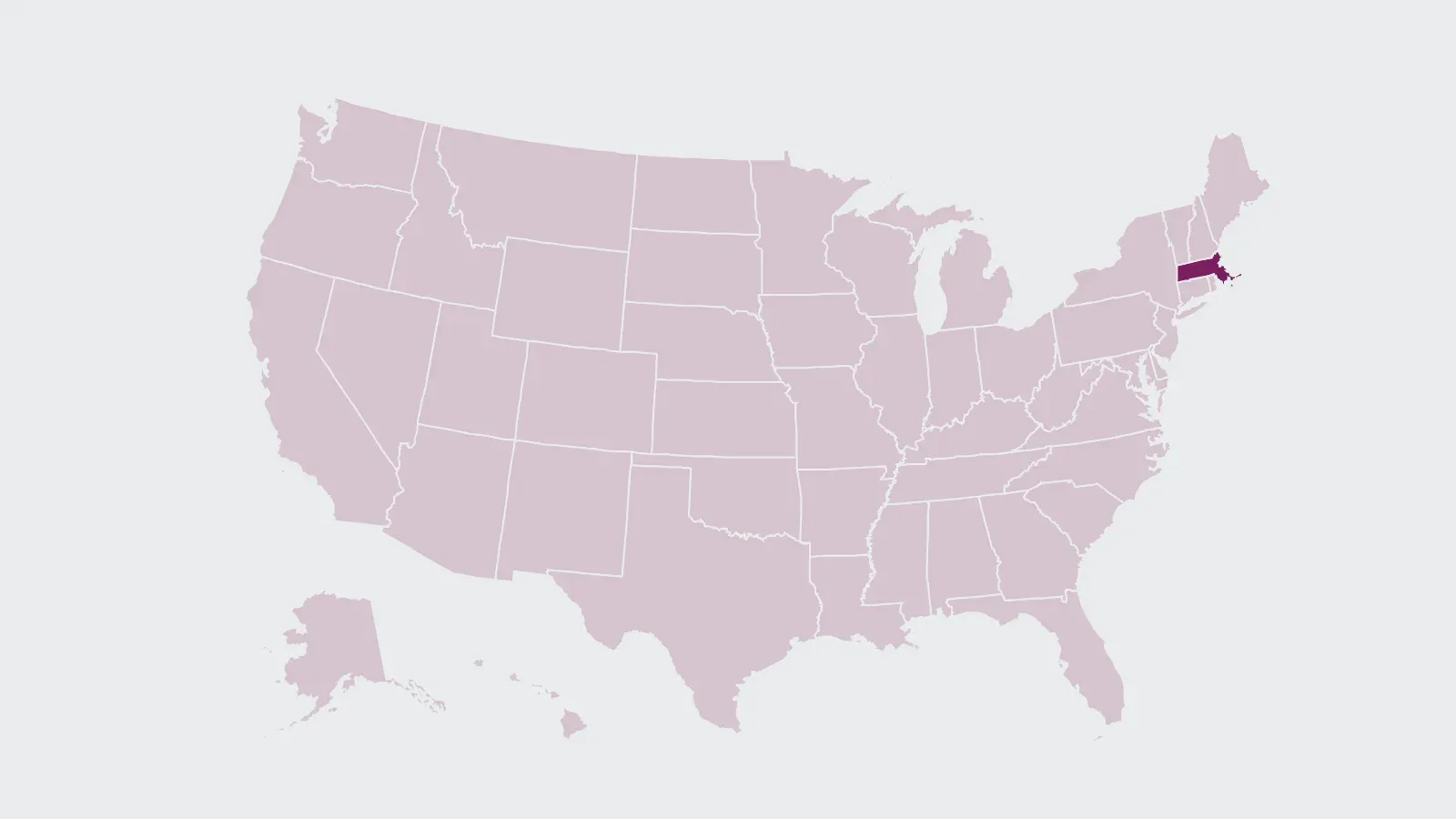
$1,250–$1,499 tier
What car insurance costs in Massachusetts
The 2023 Massachusetts bill coverage by coverage, the four parts every policy must carry, and the rules that shape what you pay.
By Guardbrook Editorial Team Updated 6 min read
At a glance
- Average yearly spend, 2023
- $1,326
- Change from 2022
- +12%
- Minimum liability limits
- 25/50/30
- Uninsured drivers, 2023
- 7.9%
Bottom line
The average Massachusetts driver spent $1,326 per insured car in 2023, a little above the U.S. figure of $1,282, while a car with liability, collision and comprehensive averaged $1,413, slightly below the national $1,438. Since July 1, 2025 every policy must carry at least 25/50 bodily injury and $30,000 property damage, plus PIP and uninsured motorist coverage. Insurers here may not use your credit, so the price rests on your driving, car, location and the discounts you claim.
The Massachusetts bill, line by line
Guardbrook
Average car insurance bill, 2023
Massachusetts
Liability$710
Collision$520
Comprehensive$183
Full coverage$1,413
Average spend per car$1,326
Compared with the U.S.+4%
Uninsured drivers7.9%
Average yearly premiums per insured car (NAIC); uninsured share: Insurance Research Council estimate. Averages, not a quote. Where these numbers come from
Price tier on the map
$1,250 to $1,499 a year
- Minimum liability limits
- 25/50/30
- Since July 1, 2025; PIP up to $8,000 and 25/50 uninsured motorist coverage also required
- Credit-based insurance scores
- Not allowed in auto pricing
- Division of Insurance: no credit information for underwriting or rating
- Regulator
- Massachusetts Division of Insurance
Massachusetts premiums next to the national figures
The National Association of Insurance Commissioners (NAIC) adds up what insurers in each state collected and divides it by the cars they covered. For 2023, the most recent year it reports by state, the Massachusetts average expenditure was $1,326 per insured car. That is 12% more than the $1,181 recorded for 2022, a rise a little smaller than the national one.
| Coverage | Massachusetts | United States |
|---|---|---|
| Liability | $710 | $737 |
| Collision | $520 | $464 |
| Comprehensive | $183 | $238 |
| All three (combined premium) | $1,413 | $1,438 |
| Average expenditure | $1,326 | $1,282 |
The lines pull in different directions. Collision runs about 12% above the U.S. average, while comprehensive, which covers theft, fire, falling objects and weather, is about 23% below it. Liability lands just under the national number. Because the average expenditure mixes liability-only cars with fully covered ones, it can sit above the U.S. figure even when the full-coverage premium sits below it. What you pay depends on your own record, car and town; see how where you live affects a price.
The four coverages every policy must include
The Massachusetts Division of Insurance lists four compulsory parts of an auto policy. As of July 1, 2025, the state raised the minimum amounts for bodily injury and property damage, so a policy written today has to carry at least:
- Bodily injury to others: $25,000 per person and $50,000 when more than one person is hurt.
- Personal injury protection (PIP): medical expenses, up to 75% of lost wages and replacement services, up to a limit of $8,000.
- Bodily injury caused by an uninsured auto: $25,000 per person and $50,000 for everyone hurt in the accident.
- Damage to someone else's property: $30,000.
Everything else is optional: higher bodily injury limits, underinsured motorist coverage, medical payments, collision, comprehensive, rental and towing. A lender will usually insist on collision and comprehensive for a financed car. With fewer than one Massachusetts driver in twelve uninsured in 2023, by the Insurance Research Council's estimate, the uninsured share is low by national standards, but the required minimums are still small next to the cost of a serious crash. Our guide to limits and deductibles shows what higher limits change on the bill.
How prices are set in Massachusetts
The Division of Insurance describes the state as a competitive marketplace, designed to push companies to offer each driver their lowest possible premium. Each insurer sorts drivers into risk groups, sets a base rate for every group and then adjusts it for the individual driver and the discounts that apply. Two companies can therefore reach quite different prices for you.
Some of those discounts are required by law. The Division names discounts for passive restraint systems and other safety features, and a discount for drivers who are 65 or older. The amount is up to each company, so ask how each quote applies them.
Massachusetts insurers are prohibited from using credit information from consumer reporting agencies for either underwriting or rating. A thin or damaged credit file should not move your auto premium here, unlike in most states; our page on credit-based insurance scores explains how the factor works elsewhere.
When no company will write your policy
If you can't find an insurer willing to cover you, an agent can place you through the Massachusetts Automobile Insurance Plan (MAIP), the state's involuntary market, administered by Commonwealth Automobile Reinsurers under rules the Division of Insurance approves. You have to try the regular market first, and companies that turn you down must explain why in writing. Any agent licensed to sell auto insurance in the state can submit the application, but you can't pick the company you're assigned to.
MAIP rates are filed with and approved by the Division and are generally higher than a company's regular rates. The assigned company compares its voluntary rate for you with the MAIP rate and charges the lower one. More on how these plans work in our guide to assigned risk plans.
Steps toward a lower Massachusetts bill
- Price the same coverage at several companies. Each insurer builds its own rate groups, so quotes on identical limits and deductibles can differ a lot.
- Confirm the required discounts are on the bill: safety features such as passive restraints, and the discount for drivers 65 and older.
- Test a higher deductible. The deductible break-even calculator shows how long it takes for the lower premium to cover the extra out-of-pocket risk.
- Ask for help if a company won't explain a price. The Division of Insurance Consumer Service Unit takes calls at 617-521-7794, Monday to Friday, 8:45 a.m. to 5 p.m.
Questions drivers ask
What are the minimum car insurance limits in Massachusetts?
Since July 1, 2025: bodily injury of $25,000 per person and $50,000 per accident, uninsured motorist bodily injury at the same amounts, $30,000 for property damage, and PIP up to $8,000.
Is car insurance more expensive in Massachusetts than in other states?
Slightly, by one measure. NAIC data for 2023 put the average expenditure at $1,326 against $1,282 nationally, but the combined premium for full coverage was $1,413, a bit below the U.S. $1,438.
Can a Massachusetts insurer use my credit score?
No. The Division of Insurance says companies are prohibited from using credit information from consumer reporting agencies for underwriting or rating auto policies.
What if every insurer turns me down?
A licensed agent can place you through the Massachusetts Automobile Insurance Plan. Its rates are generally higher, and you are charged the lower of the company's regular rate and the plan rate. See assigned risk plans.
Where the figures come from
- NAIC — Auto Insurance Database Report 2022/2023 (state average premiums and expenditures)
- Massachusetts Division of Insurance — Basics of auto insurance
- Massachusetts Division of Insurance — Massachusetts Auto Insurance Plan (MAIP) consumer guide
- Insurance Information Institute — Uninsured motorists (Insurance Research Council estimates)
Facts on this page were checked against these sources on October 26, 2026. NAIC averages are for 2023, the latest year the NAIC has published by state. The 25/50/30 minimums are the amounts in force since July 1, 2025.
Have your rate shopped
Averages can't price your car and your record. Tell us the basics of your policy and Guardbrook passes them to licensed insurance agents and insurers who can quote it; you decide whether to switch.
- 1 Your cars, drivers and current policy.
- 2 How agents can reach you, and your consent.
- 3 A licensed insurance agent or insurer contacts you with quotes. Your policy stays as it is until you decide to switch.
Guardbrook is not an insurance company or agency and doesn't sell, quote or bind policies. You pay Guardbrook nothing; the licensed insurance agents and insurers who contact you set their own prices and terms. How we make money.
Read next
-
Price factor
Credit-based insurance scores
Allowed in most states, barred from auto rates in CA, HI, MA and MI. Your rights when credit raises the price.
-
Way to save
Safety and anti-theft discounts
New York requires 5 equipment discounts and Kentucky one on comprehensive. What counts and what it is worth.
-

Shopping guide
Assigned-risk plans
Turned down twice in Texas or Maryland? How state plans place you, what they cover and how to get back out.