Under $1,000 tier
What car insurance costs in Nebraska
Nebraska's 2023 average premium against the U.S., the coverage every policy carries, and the tools the state gives you to check a price.
By Guardbrook Editorial Team Updated 6 min read
At a glance
- Average yearly spend, 2023
- $980
- Change from 2022
- +12%
- Minimum liability limits
- 25/50/25
- Uninsured drivers, 2023
- 9.5%
Bottom line
Nebraska drivers spent an average of $980 per insured car in 2023, about 24% less than the U.S. average, and full coverage averaged $1,184. Policies must carry 25/50/25 liability plus uninsured and underinsured motorist coverage of at least 25/50. Comprehensive costs far more than the national average, so that line and its deductible deserve a close look. Insurers may use credit, but not alone.
The Nebraska bill, line by line
Guardbrook
Average car insurance bill, 2023
Nebraska
Liability$484
Collision$356
Comprehensive$344
Full coverage$1,184
Average spend per car$980
Compared with the U.S.−24%
Uninsured drivers9.5%
Average yearly premiums per insured car (NAIC); uninsured share: Insurance Research Council estimate. Averages, not a quote. Where these numbers come from
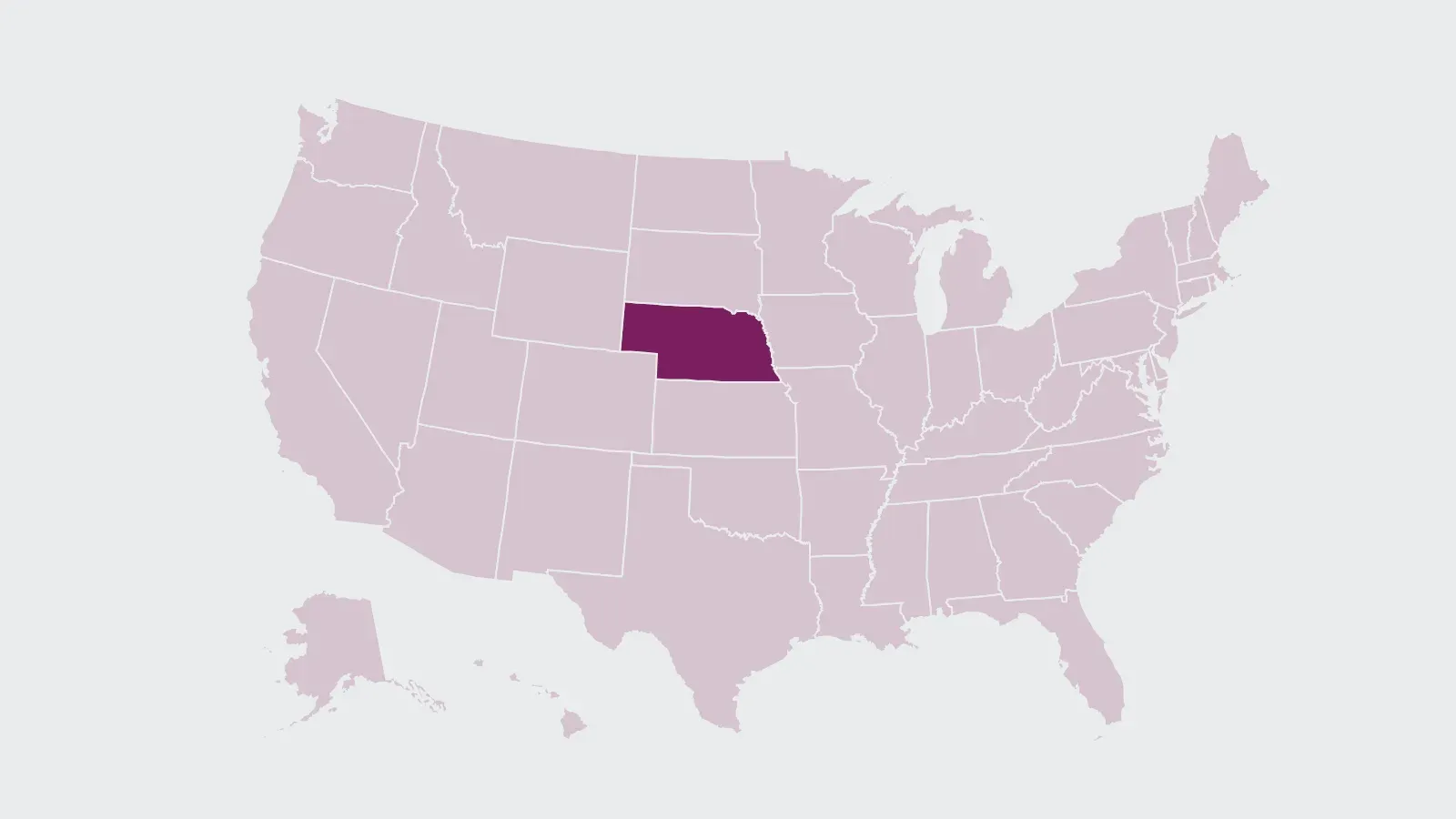
Price tier on the map
Under $1,000 a year
- Minimum liability limits
- 25/50/25
- Uninsured and underinsured motorist coverage of at least 25/50 each also required (Neb. Rev. Stat. 44-6408)
- Credit-based insurance scores
- Allowed, not as the only factor
- Neb. Rev. Stat. 44-7705; re-rate with current credit on request at renewal
- Regulator
- Nebraska Department of Insurance
Nebraska's bill, coverage by coverage
The National Association of Insurance Commissioners (NAIC) reports the average premium insurers wrote per insured car in each state. Its newest state figures, for 2023, put Nebraska's average expenditure at $980, a 12% increase from $872 in 2022, a little below the national rate of increase.
| Coverage | Nebraska | United States |
|---|---|---|
| Liability | $484 | $737 |
| Collision | $356 | $464 |
| Comprehensive | $344 | $238 |
| All three (combined premium) | $1,184 | $1,438 |
| Average expenditure | $980 | $1,282 |
Liability was about a third below the U.S. figure and collision about 23% below. Comprehensive moved the opposite way, roughly 45% higher, at $344, nearly as much as collision. Comprehensive pays for damage that isn't a collision, such as theft or storm damage. Driving less can also bring a lower price with some insurers; see how annual mileage counts.
Coverage Nebraska requires on every policy
Nebraska law defines a qualifying auto liability policy as one with at least $25,000 for injury to or death of one person, $50,000 for two or more people in one accident and $25,000 for property damage.
- Uninsured and underinsured motorist coverage must be part of any auto liability policy for a car principally garaged in Nebraska, each with limits of at least $25,000 per person and $50,000 per accident.
- Higher limits for those coverages are available if you request them in writing, up to $100,000 per person and $300,000 per accident.
- Collision and comprehensive are optional under state law, but lenders usually require them on financed cars.
About 9.5% of Nebraska drivers were uninsured in 2023, by the Insurance Research Council's estimate, below the 15.4% national figure. Underinsured coverage matters too, because a driver with only the minimum limits may not cover a serious injury. Our page on limits and deductibles explains how to weigh higher limits against the premium.
Rate filings and credit rules
Insurers file their rating systems with Nebraska's director of insurance. A filing can't take effect before the department receives it, and it is treated as meeting the law unless the director disapproves it within the review period, normally 30 days. The Department of Insurance links to SERFF Filing Access, where you can look up premium rate and policy form filings yourself.
Nebraska follows a model act on credit information in personal insurance, which covers auto policies. An insurer can't deny, cancel or refuse to renew a policy based solely on credit, and can't base renewal rates solely on credit. Missing credit information can't be held against you unless the insurer treats you as neutral or leaves credit out. At your annual renewal you, or your agent, can ask the insurer to re-rate the policy with current credit information, once in any 12 months. More on credit-based insurance scores.
When the regular market says no
The Nebraska Automobile Insurance Plan (NEAIP) offers coverage to eligible drivers who can't get it in the regular market. To qualify, you must have tried and failed to get auto insurance in Nebraska within the previous 60 days at rates no higher than the plan's, and you need a valid driver's license or eligibility for one through a filing. Only licensed Nebraska agents and brokers can submit applications. Our guide to assigned risk plans explains how this market works.
Ways to lower a Nebraska premium
- Compare quotes on identical limits. Include the same uninsured and underinsured motorist limits in each quote.
- Price a higher comprehensive and collision deductible. Our guide to raising your deductible shows when it makes sense.
- Ask for a credit re-rate at renewal if your credit has improved since the policy was written.
- Call the Department of Insurance with a complaint. Its Insurance Complaint Hotline is 877-564-7323 (in-state only); the main number is 402-471-2201.
Questions drivers ask
What car insurance is required in Nebraska?
Liability of $25,000 per person and $50,000 per accident for injuries and $25,000 for property damage, plus uninsured and underinsured motorist coverage of at least $25,000 per person and $50,000 per accident.
Is car insurance cheaper in Nebraska than the U.S. average?
Yes, on average. NAIC data for 2023 put Nebraska's average expenditure at $980 per insured car against $1,282 nationally, and full coverage at $1,184 against $1,438.
Why is comprehensive coverage high in Nebraska?
The NAIC's 2023 average for comprehensive in Nebraska was $344, about 45% above the U.S. $238. The figures don't give a cause, so compare deductibles and ask how your car and ZIP code affect the price.
Can a Nebraska insurer use my credit?
Yes, but not as the sole basis for denying, cancelling or non-renewing a policy or for setting renewal rates. You can ask for a re-rate with current credit at renewal once a year. See credit-based insurance scores.
Where the figures come from
- NAIC — Auto Insurance Database Report 2022/2023 (state average premiums and expenditures)
- Nebraska Department of Insurance — Consumer resources and complaint hotline
- Nebraska Revised Statutes 60-310 — Automobile liability policy minimums
- Nebraska Revised Statutes 44-6408 — Uninsured and underinsured motorist coverage
- Nebraska Revised Statutes 44-7705 — Insurer use of credit information
- Nebraska Revised Statutes 44-7508 — Rating system filings
- SERFF Filing Access — Nebraska rate and form filings
- Nebraska Automobile Insurance Plan (AIPSO)
- Insurance Information Institute — Uninsured motorists (Insurance Research Council estimates)
Facts on this page were checked against these sources on October 26, 2026. NAIC averages are for 2023, the latest year the NAIC has published by state. Coverage minimums are taken from Nebraska Revised Statutes 60-310 and 44-6408.
Have your rate shopped
Averages can't price your car and your record. Tell us the basics of your policy and Guardbrook passes them to licensed insurance agents and insurers who can quote it; you decide whether to switch.
- 1 Your cars, drivers and current policy.
- 2 How agents can reach you, and your consent.
- 3 A licensed insurance agent or insurer contacts you with quotes. Your policy stays as it is until you decide to switch.
Guardbrook is not an insurance company or agency and doesn't sell, quote or bind policies. You pay Guardbrook nothing; the licensed insurance agents and insurers who contact you set their own prices and terms. How we make money.
Read next
-
Price factor
Annual mileage
One of three rating factors named in California law, and a common discount elsewhere. How miles are checked.
-
Way to save
Raising your deductible
$500 to $1,000 can save $150 a year in our example and needs about 3.3 claim-free years to pay off.
-
Shopping guide
Switching insurers without a gap
Start the new policy first, cancel in writing, tell the lender. A North Carolina lapse can cost up to $200 in fees.