$1,500 or more tier
What car insurance costs in New Jersey
How the average New Jersey premium compares with the country, the policy choices that change it, and the programs for drivers with little to spend.
By Guardbrook Editorial Team Updated 7 min read
At a glance
- Average yearly spend, 2023
- $1,573
- Change from 2022
- +11%
- Minimum liability limits
- 35/70/25
- Uninsured drivers, 2023
- 14.1%
Bottom line
New Jersey drivers spent an average of $1,573 per insured car in 2023, about 23% more than the U.S. average of $1,282, and full coverage averaged $1,693. Since January 1, 2026 a Standard Policy must carry at least 35/70/25 liability, plus personal injury protection. New Jersey also hands drivers several pricing levers: the PIP limit and deductible, health insurance as primary, the right-to-sue option, and a stripped-down Basic Policy.
The New Jersey bill, line by line
Guardbrook
Average car insurance bill, 2023
New Jersey
Liability$1,033
Collision$491
Comprehensive$170
Full coverage$1,693
Average spend per car$1,573
Compared with the U.S.+23%
Uninsured drivers14.1%
Average yearly premiums per insured car (NAIC); uninsured share: Insurance Research Council estimate. Averages, not a quote. Where these numbers come from
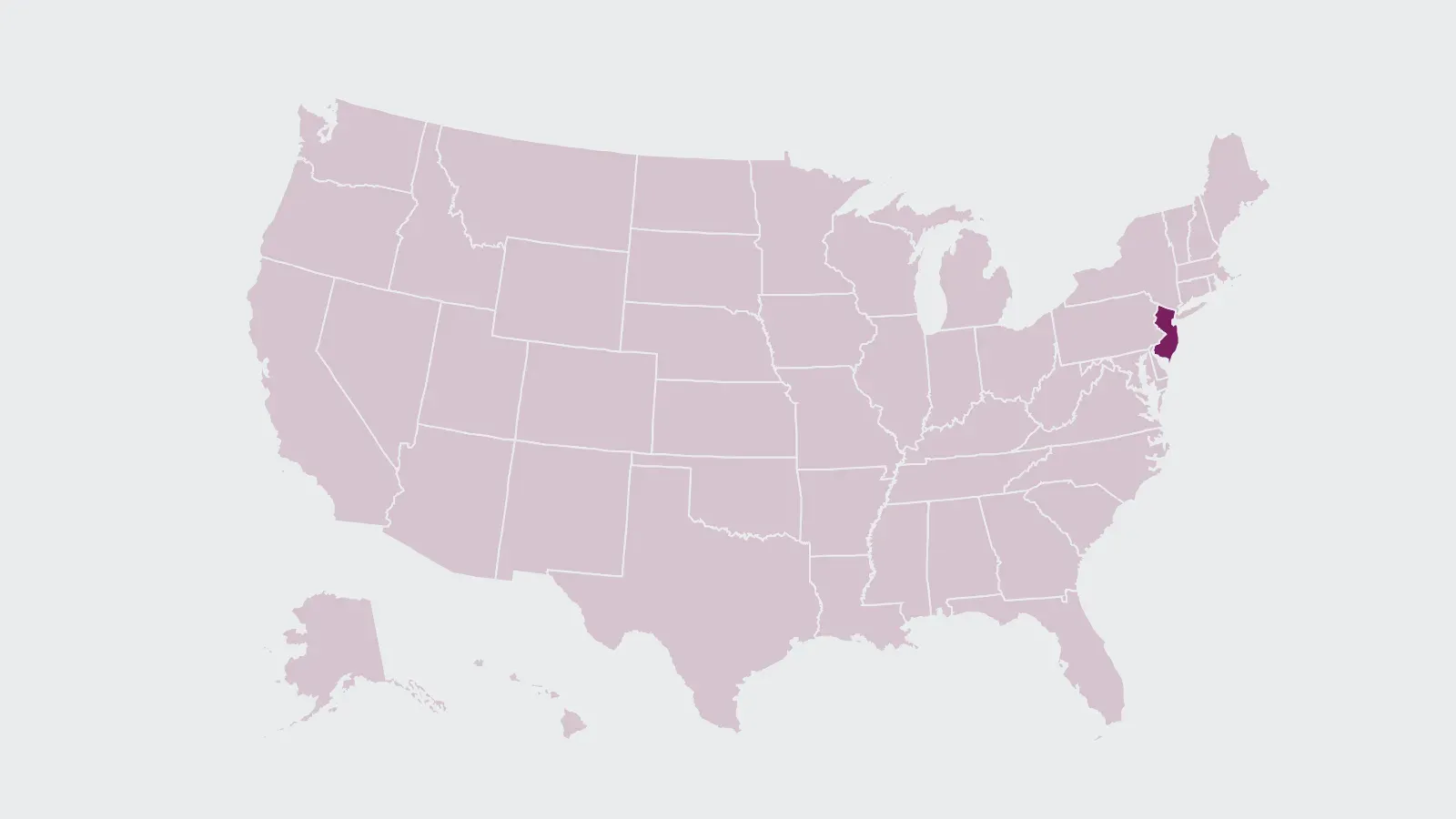
Price tier on the map
$1,500 or more a year
- Minimum liability limits
- 35/70/25 on a Standard Policy (since Jan. 1, 2026)
- PIP and UM/UIM required; Basic Policy: $15,000 PIP, $5,000 property damage, no bodily injury unless added
- Credit-based insurance scores
- Allowed, not as the only factor
- DOBI insurance scoring guide; not used for Basic Policy or Dollar-a-Day customers
- Regulator
- New Jersey Department of Banking and Insurance
New Jersey's average bill against the U.S.
The National Association of Insurance Commissioners (NAIC) publishes average premiums by state from insurers' own reports. Its 2023 figure for New Jersey is $1,573 per insured car, 11% more than the $1,411 of 2022. That average covers liability-only and fully insured cars together; a car with all three main coverages averaged $1,693.
| Coverage | New Jersey | United States |
|---|---|---|
| Liability | $1,033 | $737 |
| Collision | $491 | $464 |
| Comprehensive | $170 | $238 |
| All three (combined premium) | $1,693 | $1,438 |
| Average expenditure | $1,573 | $1,282 |
Liability drives the difference. At $1,033 it is about 40% above the national figure, while collision is only about 6% higher and comprehensive is about 29% lower. These are 2023 numbers, so they predate the January 2026 step up in required liability limits described below.
What a New Jersey Standard Policy must include
Under P.L.2022, c.87, signed on August 5, 2022, minimum liability rose in two steps. Policies issued or renewed from January 1, 2023 needed 25/50/25. From January 1, 2026 the floor is $35,000 per person and $70,000 per accident for bodily injury, with property damage unchanged at $25,000. The Department of Banking and Insurance (DOBI) reminded insurers of the second step in Bulletin 25-06.
- Personal injury protection (PIP) pays medical bills after a crash. DOBI's buyer's guide lists medical limits from $15,000 to $250,000 and deductibles from $250 to $2,500, with a 20% copayment on costs between the deductible and $5,000.
- Health insurance as primary can cut the PIP cost if your health plan will pay first. Medicare and Medicaid can't be used for this option.
- Uninsured/underinsured motorist coverage is required at a minimum amount, and a Standard Policy can carry it up to your liability limits.
- Right to sue: the limited option, which allows pain-and-suffering suits only for listed permanent injuries, costs less than the unlimited option.
Each of these choices moves the premium, and the cheaper settings shift risk back to you. Our page on limits and deductibles helps you decide which trade-offs fit your savings and health coverage.
The Basic Policy and the $365 Medicaid policy
Basic Policy
PIP of $15,000 per person per accident, plus up to $250,000 for certain injuries, and $5,000 of property damage liability. Bodily injury liability isn't included; $10,000 per accident is an option. It has no uninsured motorist coverage and comes with the limited right to sue.
Special Policy for Medicaid recipients
For drivers eligible for federal Medicaid with hospitalization. It is a medical-only policy and costs $365 a year, according to DOBI's buyer's guide.
Both cover far less than a Standard Policy: with no bodily injury liability, or only $10,000 of it, a serious crash you cause can leave you personally exposed for the rest. Weigh that before choosing on price alone. Our guide to state low-cost programs compares New Jersey's options with those in other states.
Credit and the residual market in New Jersey
DOBI's consumer guide to insurance scoring says insurers that use it must tell policyholders, list the factors involved and file their scoring model with the Department. Scoring can't be the only factor in a rate, can't consider race, ethnicity, sex, age, religion, income or address, and can't be used at all for Basic Policy or Dollar-a-Day customers. A driver with no credit history can't be put in a below-standard tier for that reason alone, and insurers must make exceptions for events such as catastrophic illness, divorce or identity theft. See how credit-based scores work.
Drivers who can't find coverage in the regular market can apply through the New Jersey Automobile Insurance Plan (NJAIP), an assignment mechanism run by a governing committee under a plan of operation approved by the Commissioner. A licensed agent can submit the application; our page on assigned risk plans explains what to expect.
Ways to trim a New Jersey premium
- Get quotes on identical settings. Fix the liability limits, PIP limit and deductible, health-primary choice and right-to-sue option before you compare; otherwise the numbers can't be lined up.
- Test the PIP deductible and health-primary option. DOBI lists both among the ways to lower the cost, but check that your health plan actually pays first for car-crash injuries.
- Raise the physical damage deductible if you can afford it. The deductible break-even calculator shows how many claim-free years it takes to come out ahead.
- Call DOBI if something is wrong. The Consumer Hotline is 800-446-7467; the Department's main number is 609-292-7272.
Questions drivers ask
What are New Jersey's minimum car insurance limits in 2026?
For a Standard Policy issued or renewed on or after January 1, 2026: $35,000 per person and $70,000 per accident for bodily injury and $25,000 for property damage, plus PIP and uninsured motorist coverage.
What is the New Jersey Basic Policy?
A reduced policy with $15,000 of PIP (up to $250,000 for certain injuries) and $5,000 of property damage liability. Bodily injury liability is optional at $10,000, and there is no uninsured motorist coverage.
Is there a low-cost car insurance policy for Medicaid recipients in New Jersey?
Yes. Drivers eligible for federal Medicaid with hospitalization can buy a medical-only special policy for $365 a year.
Why is New Jersey car insurance more expensive than average?
The NAIC figures show where the difference sits rather than why: liability averaged $1,033 in 2023 against $737 nationally, while comprehensive was below the U.S. figure.
Where the figures come from
- NAIC — Auto Insurance Database Report 2022/2023 (state average premiums and expenditures)
- New Jersey DOBI — Auto Insurance New Jersey Buyer's Guide
- New Jersey DOBI — Bulletin 25-06, increased automobile liability limits (P.L.2022, c.87)
- New Jersey DOBI — Insurance scoring consumer guide
- AIPSO — New Jersey Automobile Insurance Plan
- Insurance Information Institute — Uninsured motorists (Insurance Research Council estimates)
Facts on this page were checked against these sources on October 26, 2026. NAIC averages are for 2023, the latest year the NAIC has published by state, and predate the 35/70/25 minimum that took effect on January 1, 2026.
Have your rate shopped
Averages can't price your car and your record. Tell us the basics of your policy and Guardbrook passes them to licensed insurance agents and insurers who can quote it; you decide whether to switch.
- 1 Your cars, drivers and current policy.
- 2 How agents can reach you, and your consent.
- 3 A licensed insurance agent or insurer contacts you with quotes. Your policy stays as it is until you decide to switch.
Guardbrook is not an insurance company or agency and doesn't sell, quote or bind policies. You pay Guardbrook nothing; the licensed insurance agents and insurers who contact you set their own prices and terms. How we make money.
Read next
-
Shopping guide
State low-cost programs
California's 10/20/3 policy, New Jersey's $365 Medicaid policy, Hawaii's free minimums and Maryland's MAIF.
-
Price factor
Coverage limits and deductibles
What 25/50/25 means, why liability is about half of a $1,438 full-coverage bill, and how to size a deductible.
-

Way to save
Raising your deductible
$500 to $1,000 can save $150 a year in our example and needs about 3.3 claim-free years to pay off.