Under $1,000 tier
What car insurance costs in South Dakota
A low average bill with one expensive line: South Dakota's premium against the U.S., the coverage the state requires, and where to trim.
By Guardbrook Editorial Team Updated 5 min read
At a glance
- Average yearly spend, 2023
- $936
- Change from 2022
- +14%
- Minimum liability limits
- 25/50/25
- Uninsured drivers, 2023
- 9.4%
Bottom line
South Dakota drivers spent an average of $936 per insured car in 2023, about 27% below the U.S. average of $1,282, and a fully covered car averaged $1,158. Liability cost about half the national figure, but comprehensive, at $473, was nearly double it. South Dakota requires 25/50/25 liability, and every policy also carries uninsured and underinsured motorist coverage that matches your liability limits.
The South Dakota bill, line by line
Guardbrook
Average car insurance bill, 2023
South Dakota
Liability$378
Collision$307
Comprehensive$473
Full coverage$1,158
Average spend per car$936
Compared with the U.S.−27%
Uninsured drivers9.4%
Average yearly premiums per insured car (NAIC); uninsured share: Insurance Research Council estimate. Averages, not a quote. Where these numbers come from
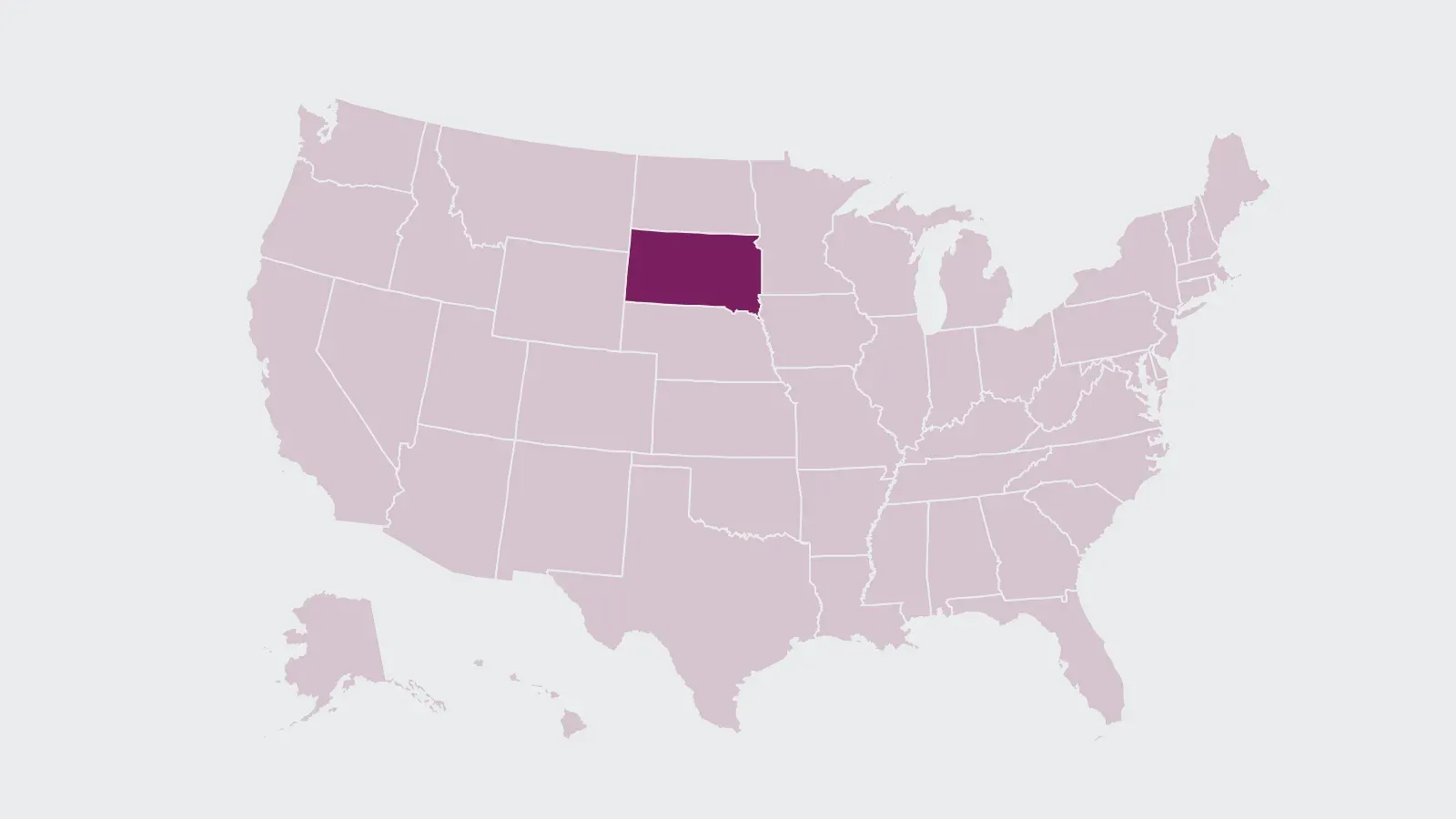
Price tier on the map
Under $1,000 a year
- Minimum liability limits
- 25/50/25
- UM and UIM required at your bodily injury limits, up to 100/300 unless you ask for more (SDCL 58-11-9, 58-11-9.4)
- Credit-based insurance scores
- No state rule confirmed
- South Dakota Division of Insurance auto guidance does not address it; ask each insurer
- Regulator
- South Dakota Division of Insurance
South Dakota's bill against the national one
The National Association of Insurance Commissioners (NAIC) reports, state by state, what insurers collected per insured car. In 2023, its latest state year, South Dakota's average expenditure was $936, up 14% from $823 in 2022, the same rise as the U.S. as a whole. The average includes liability-only cars alongside fully covered ones. For a car carrying liability, collision and comprehensive, the combined premium was $1,158.
| Coverage | South Dakota | United States |
|---|---|---|
| Liability | $378 | $737 |
| Collision | $307 | $464 |
| Comprehensive | $473 | $238 |
| All three (combined premium) | $1,158 | $1,438 |
| Average expenditure | $936 | $1,282 |
The table splits sharply. Liability was $378, about half the national $737, and collision was $157 lower too. Comprehensive went the other way: $473 against $238, the largest line on a fully covered South Dakota car. Comprehensive pays for damage that isn't a collision with another car, such as theft, fire or hail, and it is the coverage whose deductible you set. Our page on raising your deductible shows how that choice moves the price.
The coverage South Dakota requires
South Dakota law (SDCL 32-35-70) requires an owner's liability policy of at least $25,000 for injury to or death of one person, $50,000 for two or more people in one accident and $25,000 for damage to others' property: 25/50/25.
- Uninsured motorist coverage is required on every policy. It pays for your injuries caused by an uninsured or hit-and-run driver, not for damage to your car.
- Underinsured motorist coverage must be included as well. It pays for injuries caused by a driver whose insurance is too small for the harm done.
- Both match your liability limits. State law sets uninsured and underinsured coverage equal to your bodily injury limits, up to $100,000 per person and $300,000 per accident unless you ask for more. The Division of Insurance notes that the two can't be stacked.
- Collision and comprehensive are optional under state law, though a lender will normally require them on a financed vehicle.
Because uninsured and underinsured coverage rise with your liability limits, buying more liability also buys more protection for yourself. The Insurance Research Council estimates that 9.4% of South Dakota drivers were uninsured in 2023, well under the U.S. rate of 15.4%. Our guide to limits and deductibles helps you weigh higher limits against their cost.
Pricing, filings and credit
The Division of Insurance, part of the Department of Labor and Regulation, links from its auto insurance page to a public search of insurers' rate filings and to company market share reports. Looking up what your company has filed can help you frame questions if a renewal surprises you.
The Division's auto insurance guidance does not address credit-based insurance scores, and we could not confirm a South Dakota rule on them from an official source. Ask each company whether it uses one when you request a quote, and read our page on credit-based insurance scores for how they generally work.
If no company will insure you
If you can't find an insurer willing to cover you, a local insurance producer can submit an application to the South Dakota Automobile Plan on your behalf. It is a fallback for drivers the regular market turns down; our guide to assigned risk plans explains how such plans work and when to try the regular market again.
Trimming a South Dakota bill
- Start with comprehensive. It is the costliest line on an average fully covered car in South Dakota, so compare quotes at two or three deductible levels.
- Do the math on the deductible. The deductible break-even calculator shows how many claim-free years a higher deductible needs to pay off.
- Compare at least two or three insurers on identical liability limits, since your uninsured and underinsured coverage follows those limits.
- Contact the Division of Insurance at 605-773-3563 if a dispute with your insurer stalls; complaints can also be filed online.
Questions drivers ask
Is car insurance cheap in South Dakota?
Below average overall. NAIC's 2023 data put South Dakota at $936 per insured car against $1,282 for the U.S., but comprehensive coverage averaged $473, nearly double the national $238.
What is the minimum car insurance in South Dakota?
Liability of 25/50/25, plus uninsured and underinsured motorist coverage equal to your bodily injury liability limits.
Can I stack uninsured motorist coverage in South Dakota?
No. The South Dakota Division of Insurance says uninsured and underinsured motorist coverages are not stackable.
Where do high-risk drivers get insurance in South Dakota?
Through the South Dakota Automobile Plan. A local insurance producer submits the application for you.
Where the figures come from
- NAIC — Auto Insurance Database Report 2022/2023 (state average premiums and expenditures)
- South Dakota Division of Insurance — Automobile insurance
- South Dakota Division of Insurance — Consumer information and complaints
- SDCL 32-35-70 — Minimum liability limits
- SDCL 58-11-9 — Uninsured motorist coverage
- SDCL 58-11-9.4 — Underinsured motorist coverage
- U.S. Bureau of Labor Statistics — CPI, table 2 (motor vehicle insurance)
- Insurance Information Institute — Uninsured motorists (Insurance Research Council estimates)
Facts on this page were checked against these sources on October 26, 2026. NAIC averages are for 2023, the latest year the NAIC has published by state.
Have your rate shopped
Averages can't price your car and your record. Tell us the basics of your policy and Guardbrook passes them to licensed insurance agents and insurers who can quote it; you decide whether to switch.
- 1 Your cars, drivers and current policy.
- 2 How agents can reach you, and your consent.
- 3 A licensed insurance agent or insurer contacts you with quotes. Your policy stays as it is until you decide to switch.
Guardbrook is not an insurance company or agency and doesn't sell, quote or bind policies. You pay Guardbrook nothing; the licensed insurance agents and insurers who contact you set their own prices and terms. How we make money.
Read next
-
Price factor
Coverage limits and deductibles
What 25/50/25 means, why liability is about half of a $1,438 full-coverage bill, and how to size a deductible.
-
Way to save
Raising your deductible
$500 to $1,000 can save $150 a year in our example and needs about 3.3 claim-free years to pay off.
-
Shopping guide
Assigned-risk plans
Turned down twice in Texas or Maryland? How state plans place you, what they cover and how to get back out.