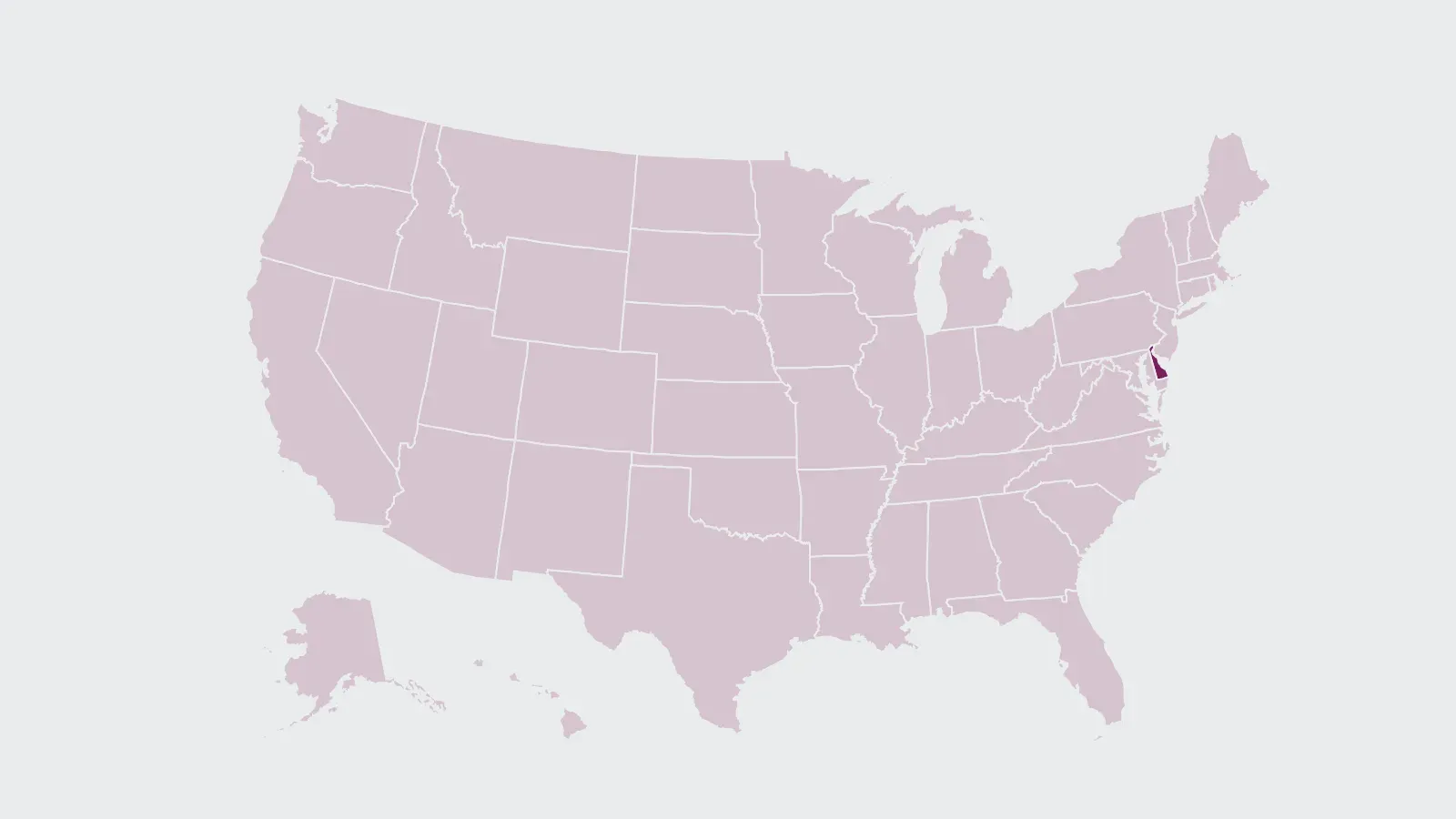
$1,250–$1,499 tier
What car insurance costs in Delaware
Delaware's average bill split into its parts, the coverages state law adds to every policy, and the levers a Delaware driver can pull.
By Guardbrook Editorial Team Updated 6 min read
At a glance
- Average yearly spend, 2023
- $1,462
- Change from 2022
- +13%
- Minimum liability limits
- 25/50/10
- Uninsured drivers, 2023
- 17.6%
Bottom line
The average Delaware driver spent $1,462 per insured car in 2023, 14% more than the U.S. figure of $1,282, and a car carrying liability, collision and comprehensive averaged $1,569. The whole gap sits in the liability line: physical damage coverage actually costs less than the national average. Every policy must carry 25/50/10 liability plus personal injury protection of $15,000 per person, and a state regulation sets a 10% discount for an approved defensive driving course.
The Delaware bill, line by line
Guardbrook
Average car insurance bill, 2023
Delaware
Liability$962
Collision$423
Comprehensive$184
Full coverage$1,569
Average spend per car$1,462
Compared with the U.S.+14%
Uninsured drivers17.6%
Average yearly premiums per insured car (NAIC); uninsured share: Insurance Research Council estimate. Averages, not a quote. Where these numbers come from
Price tier on the map
$1,250 to $1,499 a year
- Minimum liability limits
- 25/50/10
- Plus PIP of $15,000 per person / $30,000 per accident; uninsured motorist coverage unless rejected in writing
- Credit-based insurance scores
- Allowed, not as the only factor
- 18 Del. C. ch. 83; exceptions for divorce, illness, job loss, identity theft and other life events
- Regulator
- Delaware Department of Insurance
Delaware's bill next to the national average
The figures below come from the National Association of Insurance Commissioners (NAIC), which adds up the premiums insurers actually collected in each state. For 2023, its latest state year, Delaware's average expenditure was $1,462 per insured car, 13% more than the $1,296 of 2022. That average blends cars with liability only and cars with full coverage. A car carrying all three main coverages cost $1,569.
| Coverage | Delaware | United States |
|---|---|---|
| Liability | $962 | $737 |
| Collision | $423 | $464 |
| Comprehensive | $184 | $238 |
| All three (combined premium) | $1,569 | $1,438 |
| Average expenditure | $1,462 | $1,282 |
Read the rows one at a time and the pattern is clear. Liability averaged $962, about 31% above the U.S. number. Collision ($423) and comprehensive ($184) were both below it. So a Delawarean pays more mainly for the liability side of the policy, not for repairing their own car. The NAIC tables don't say why; your own quote still depends on your driving history, vehicle and garaging address, as our page on how location sets a price explains.
Coverage Delaware requires on every car
Delaware's financial responsibility law sets liability minimums of $25,000 for one injured person, $50,000 for all injuries in one accident and $10,000 for property damage: 25/50/10. On top of liability, the state's insurance statute requires two more pieces.
- Personal injury protection (PIP) of at least $15,000 per person and $30,000 per accident, with funeral costs capped at $5,000. It pays your own medical bills and other covered losses after a crash.
- Uninsured motorist coverage is part of the policy at no less than the minimum liability limits, unless a named insured rejects it in writing on the insurer's form. A rejection carries over to renewals until you ask for the coverage back in writing.
- Extra uninsured and underinsured coverage must be offered to you as an option to buy. With about 17.6% of Delaware drivers uninsured in 2023, by the Insurance Research Council's estimate, the offer deserves a real look.
A $10,000 property damage limit is low next to what a new car costs today. If you can afford it, price a higher limit before you settle on the minimum; our guide to coverage limits and deductibles shows how each choice moves the premium.
How Delaware oversees rates and credit
Insurers must file every rate, rating plan and rating rule with the Insurance Commissioner at least 60 days before they plan to use it. A filing counts as meeting the law once 60 days pass, unless the Commissioner disapproves it or asks for more time, which can stretch the review to 90 days. Rates that clear this review can still differ a great deal from one company to the next.
Credit-based insurance scores are allowed under Chapter 83 of Title 18, with guardrails. An insurer can't refuse, cancel or nonrenew a policy based only on credit, and it can't set a renewal rate on credit alone. If a catastrophe, serious illness or injury, the death of a close family member, divorce, identity theft or a job loss lasting three months or more damaged your credit, you can ask in writing for an exception. If credit leads to a worse price, the company must tell you why, naming up to four main factors. Background: how credit-based scores affect premiums.
When regular insurers say no
The Delaware Automobile Insurance Plan covers drivers who can't buy a policy in the regular market. To be placed through it you need a valid Delaware driver's license and a car registered in Delaware, and any agent licensed for property and casualty insurance in the state can submit the application. Plan coverage usually costs more, so treat it as a bridge while your record improves. Our page on assigned risk plans explains how these plans work.
Ways to lower a Delaware premium
- Take an approved defensive driving course. Under the Department of Insurance's regulation, completing one earns a 10% discount on bodily injury, property damage and PIP premiums for three years. A refresher course finished within 180 days before those three years end lifts it to 15%.
- Collect quotes on identical coverage. Ask two or three insurers to price the same limits, the same PIP and the same deductibles, then compare them line by line.
- Test a higher deductible. Collision and comprehensive are already cheaper than average in Delaware, but a bigger deductible can still trim them; the deductible break-even calculator shows when it pays off.
- Report problems to the regulator. If a claim or a rate change looks wrong and the insurer doesn't fix it, you can file a complaint with the Delaware Department of Insurance.
Questions drivers ask
Why is car insurance in Delaware above the national average?
The difference is in liability. NAIC data for 2023 put Delaware's liability average at $962 against $737 nationally, while collision and comprehensive were cheaper than the U.S. averages.
Do I have to buy PIP in Delaware?
Yes. Every Delaware policy must include personal injury protection of at least $15,000 per person and $30,000 per accident.
Can I turn down uninsured motorist coverage in Delaware?
Yes, but only in writing on the insurer's rejection form. The rejection stays on later renewals unless you ask for the coverage again in writing.
Is there a discount for a defensive driving course in Delaware?
Yes. A state regulation sets a 10% discount on bodily injury, property damage and PIP premiums for three years after you complete an approved course, and 15% after a timely refresher course.
Where the figures come from
- NAIC — Auto Insurance Database Report 2022/2023 (state average premiums and expenditures)
- Delaware Code, Title 21, § 2118 — Required insurance and personal injury protection
- Delaware Code, Title 21, § 2902 — Financial responsibility minimum limits
- Delaware Code, Title 18, § 3902 — Uninsured and underinsured vehicle coverage
- Delaware Code, Title 18, Chapter 25 — Rate filings
- Delaware Code, Title 18, Chapter 83 — Use of credit information in insurance
- Delaware Register of Regulations, March 2015 — Defensive driving course premium reduction
- AIPSO — Delaware Automobile Insurance Plan
- Insurance Information Institute — Uninsured motorists (Insurance Research Council estimates)
Facts on this page were checked against these sources on October 26, 2026. NAIC averages are for 2023, the latest year the NAIC has published by state.
Have your rate shopped
Averages can't price your car and your record. Tell us the basics of your policy and Guardbrook passes them to licensed insurance agents and insurers who can quote it; you decide whether to switch.
- 1 Your cars, drivers and current policy.
- 2 How agents can reach you, and your consent.
- 3 A licensed insurance agent or insurer contacts you with quotes. Your policy stays as it is until you decide to switch.
Guardbrook is not an insurance company or agency and doesn't sell, quote or bind policies. You pay Guardbrook nothing; the licensed insurance agents and insurers who contact you set their own prices and terms. How we make money.
Read next
-
Price factor
Coverage limits and deductibles
What 25/50/25 means, why liability is about half of a $1,438 full-coverage bill, and how to size a deductible.
-
Way to save
Defensive driving course discount
At least 10% in Minnesota for drivers 55+, 10% in Delaware at any age. State rules, how long it lasts, how to claim.
-
Shopping guide
When to shop for car insurance
Renewal notices (45 days ahead in Maryland), moves, new cars and drivers, and old tickets that stop counting.