$1,250–$1,499 tier
What car insurance costs in Nevada
Nevada's average bill set against the national one, the state rules every policy has to meet, and the levers a Nevada driver can actually pull.
By Guardbrook Editorial Team Updated 6 min read
At a glance
- Average yearly spend, 2023
- $1,461
- Change from 2022
- +13%
- Minimum liability limits
- 25/50/20
- Uninsured drivers, 2023
- 11.1%
Bottom line
Nevada drivers spent an average of $1,461 per insured car in 2023, roughly 14% more than the national $1,282, and a car carrying liability, collision and comprehensive averaged $1,600. Almost all of the gap comes from liability coverage. State law requires 25/50/20 liability, insurers must offer uninsured motorist coverage, and every personal auto rate needs the Division of Insurance's approval before use.
The Nevada bill, line by line
Guardbrook
Average car insurance bill, 2023
Nevada
Liability$1,040
Collision$424
Comprehensive$136
Full coverage$1,600
Average spend per car$1,461
Compared with the U.S.+14%
Uninsured drivers11.1%
Average yearly premiums per insured car (NAIC); uninsured share: Insurance Research Council estimate. Averages, not a quote. Where these numbers come from
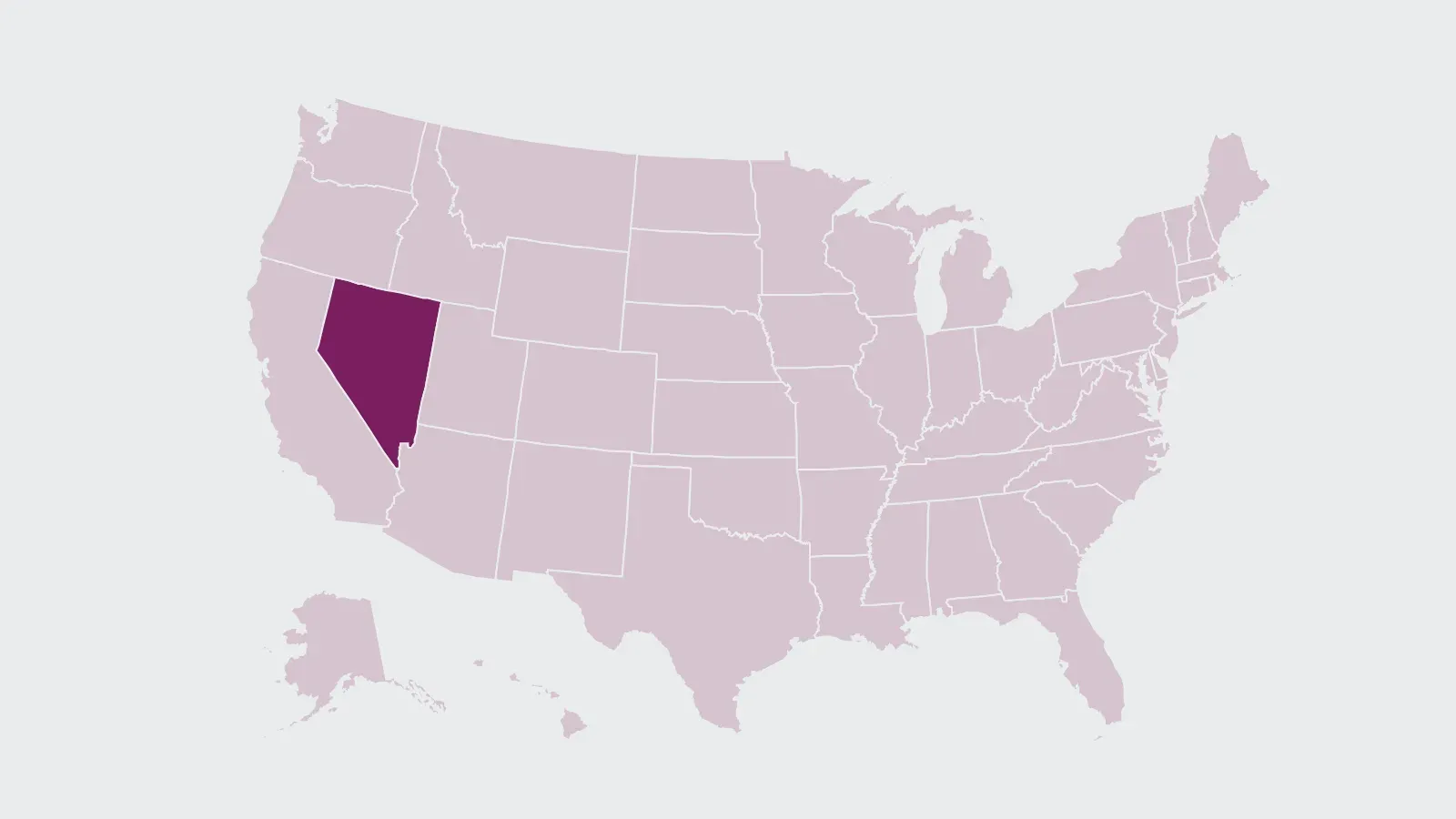
Price tier on the map
$1,250 to $1,499 a year
- Minimum liability limits
- 25/50/20
- Insurers must offer UM/UIM at your liability limits and MedPay; both can be declined
- Credit-based insurance scores
- Allowed, not as the only factor
- NRS 686A.680; exceptions for extraordinary life events under NRS 686A.685
- Regulator
- Nevada Division of Insurance
Nevada's 2023 bill, line by line
The figures below come from the National Association of Insurance Commissioners (NAIC), which compiles the premiums insurers actually collected in each state. For 2023 the average Nevada expenditure was $1,461 per insured car, 13% more than the $1,291 recorded for 2022. Expenditure blends liability-only policies with full coverage; a car carrying all three main coverages averaged $1,600.
| Coverage | Nevada | United States |
|---|---|---|
| Liability | $1,040 | $737 |
| Collision | $424 | $464 |
| Comprehensive | $136 | $238 |
| All three (combined premium) | $1,600 | $1,438 |
| Average expenditure | $1,461 | $1,282 |
The shape of the Nevada bill is unusual. Liability, at $1,040, runs about 41% above the national line, while collision is about 9% below it and comprehensive, at $136, is about 43% below. Only Hawaii had a lower comprehensive average in the 2023 tables. So the part of the premium that pays for damage you cause to others carries most of the weight, and that part depends heavily on where the car is garaged; see how ZIP code shapes a price.
Coverage Nevada requires on every policy
The Nevada DMV lists the floor as $25,000 for bodily injury or death of one person, $50,000 for two or more people in one accident and $20,000 for damage to other people's property, written 25/50/20. The Division of Insurance notes these limits took effect on July 1, 2018. Insurers confirm Nevada liability policies to the DMV electronically through a program called NV LIVE, and the DMV checks coverage during the year as well as at registration.
- Uninsured/underinsured motorist coverage is optional, but under NRS 687B.145(2) your insurer has to offer it at limits equal to your own liability limits. You may decline it. It does not pay to fix your own car.
- Medical payments coverage must also be offered under NRS 687B.145(3). You are not required to buy it.
- Collision and comprehensive are your choice under state law; a lender or lessor will usually make them a condition of the loan.
Because the required limits are low and liability is already the biggest line on a Nevada bill, raising them can cost more than you expect, and cutting them saves less than it seems. Our guide to limits and deductibles shows how to weigh each layer.
How Nevada reviews rates and credit
The Division of Insurance describes Nevada as a prior-approval state for personal auto rates: an insurer may charge only rates the Division has approved. Large or complex increases can go through several rounds of questions, and the insurer has 30 days to answer each one. Approval does not make prices uniform; each company still builds its own rating plan.
Credit-based insurance scores are allowed, and the Division publishes lists of companies that use them and companies that don't. NRS 686A.680 bars an insurer from refusing, canceling or not renewing a policy on credit alone, and a thin or missing credit file must be treated no worse than neutral credit. You may ask for a re-score once every 12 months, and NRS 686A.685 requires reasonable exceptions, on written request, when a catastrophe, serious illness, a death in the family, divorce, identity theft, long-term job loss or overseas deployment damaged your credit. More on how insurers use credit.
When regular insurers say no
The Nevada Automobile Insurance Plan exists for drivers who look for coverage and can't get it in the voluntary market. The plan's page on the AIPSO site refers questions to the Western Association of Automobile Insurance Plans at 800-227-4659. A licensed agent can tell you whether you qualify; our overview of assigned risk plans explains how these policies are priced and how to move back to a regular insurer.
Ways to lower a Nevada premium
- Use the Division's rate survey. Its 2026 Consumer's Guide to Automobile Insurance Rates prints sample premiums from many insurers for nine Nevada cities. Use it to pick companies to call, then request quotes with matching limits.
- Take the 55-plus course if it applies. The one discount Nevada law requires is for drivers 55 and older who finish a DMV-approved driving course: insurers must reduce the premium for three years as long as the record stays clean.
- Price the deductible. Collision is the second-largest line; a higher deductible lowers it, and the deductible break-even calculator shows how long the savings take to cover the extra risk.
- Escalate if you're stuck. Go to your insurer first. After that, the Division's Consumer Services staff take calls at 888-872-3234 (toll-free in Nevada), 775-687-0700 in Carson City and 702-486-4009 in Las Vegas.
Questions drivers ask
Why is liability coverage so expensive in Nevada?
The NAIC data show the size of the gap, not its cause: Nevada's 2023 liability average was $1,040 against $737 nationally. Comprehensive, by contrast, was $136, one of the lowest figures in the country.
What are the minimum car insurance limits in Nevada?
25/50/20: $25,000 for one person's injuries, $50,000 for two or more people in one accident and $20,000 for property damage. Insurers must also offer uninsured motorist and medical payments coverage, which you can decline.
Does Nevada approve car insurance rates?
Yes. The Division of Insurance calls Nevada a prior-approval state for personal auto insurance, so an insurer may use only rates the Division has approved.
Is there a senior discount required by Nevada law?
Drivers 55 and older who complete a DMV-approved driving course get a premium reduction for three years if they keep a clean record. See course discounts.
Where the figures come from
- NAIC — Auto Insurance Database Report 2022/2023 (state average premiums and expenditures)
- Nevada Division of Insurance — 2026 Consumer's Guide to Automobile Insurance Rates
- Nevada Division of Insurance — Auto Insurance FAQs
- Nevada Division of Insurance — Credit Scoring FAQs (NRS 686A.680–686A.710)
- Nevada DMV — Insurance requirements and NV LIVE
- AIPSO — Nevada Automobile Insurance Plan
- Insurance Information Institute — Uninsured motorists (Insurance Research Council estimates)
Facts on this page were checked against these sources on October 26, 2026. NAIC averages are for 2023, the latest year the NAIC has published by state.
Have your rate shopped
Averages can't price your car and your record. Tell us the basics of your policy and Guardbrook passes them to licensed insurance agents and insurers who can quote it; you decide whether to switch.
- 1 Your cars, drivers and current policy.
- 2 How agents can reach you, and your consent.
- 3 A licensed insurance agent or insurer contacts you with quotes. Your policy stays as it is until you decide to switch.
Guardbrook is not an insurance company or agency and doesn't sell, quote or bind policies. You pay Guardbrook nothing; the licensed insurance agents and insurers who contact you set their own prices and terms. How we make money.
Read next
-
Price factor
Coverage limits and deductibles
What 25/50/25 means, why liability is about half of a $1,438 full-coverage bill, and how to size a deductible.
-
Way to save
Defensive driving course discount
At least 10% in Minnesota for drivers 55+, 10% in Delaware at any age. State rules, how long it lasts, how to claim.
-
Shopping guide
Complaining about a rate increase
Ask the insurer, use your adverse action rights, read the filing, then complain; Maryland gives you 30 days.